
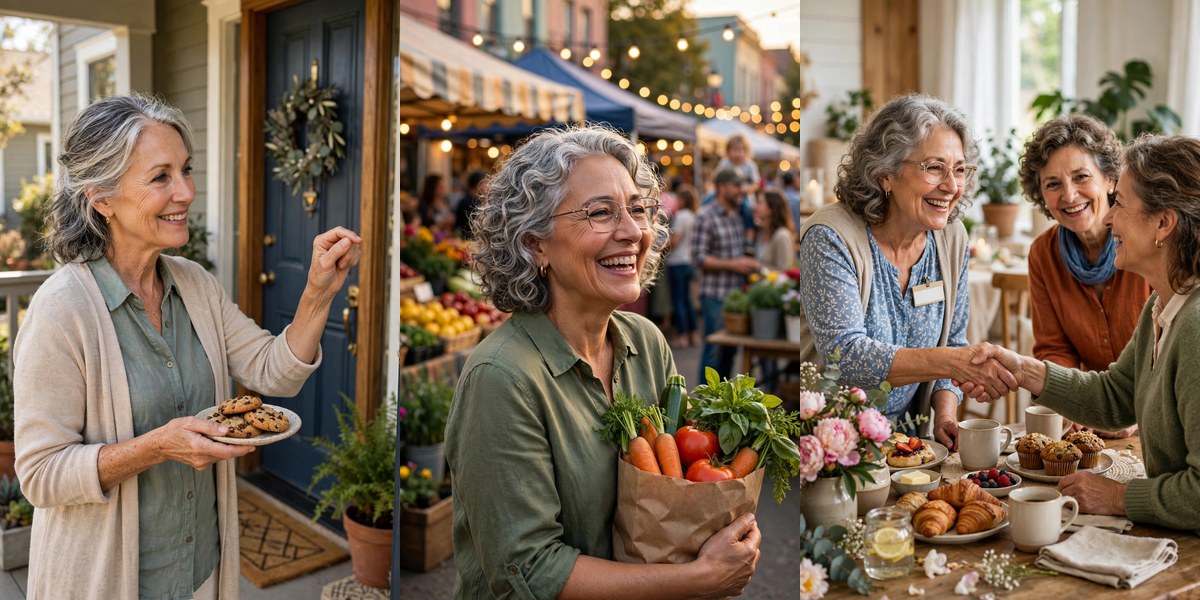
The moving truck has pulled away. The boxes are stacked in the hallway, the kettle has been found, and you are sitting on a sofa that hasn’t found its corner yet — in a town where you don’t know a single soul. Your address changed overnight, but your people are still hundreds of miles back in the old place.
If your chest feels a little tight when you think about starting over socially, there is nothing wrong with you. Making friends as an adult is hard enough; making them from zero, in a place where every street is unfamiliar, can feel almost impossible. Most women who move later in life say the loneliness of those first weeks surprised them more than anything else about the move.
Here is the gentle truth: you don’t need to become an extrovert, join everything, or charm the whole street. New-town friendships grow the same way all adult friendships do — through small, repeated hellos. Below are 22 warm, genuinely doable ways to meet new people after moving to a new town, each one small enough to try this week.
💭 Why a New Town Can Feel So Lonely at First
In your old town, friendship ran on geography and history: the neighbor you’d waved at for a decade, the friend who knew your coffee order, the streets that held your memories. A new town strips all of that away at once — and it’s completely natural to feel unmoored, even when the move itself was your choice.
There is also the story we tell ourselves: everyone here already has their friends. Almost every newcomer believes it, and almost every newcomer is wrong. Most adults quietly wish for one or two more genuine friends, and the woman across the room at that first newcomers coffee is just as nervous as you. Someone has to say hello first — and there is no rule saying it can’t be you.
1. 🚪 Knock on three doors your first week

Old-fashioned? Absolutely. Effective? Enormously. A quick knock, a warm smile, and “Hi, I’m ___ — I just moved in next door” is still the fastest way to turn strangers on your street into familiar faces. Most people are delighted, because almost nobody does it anymore.
Try this: Bring something small and edible — a few cookies, a jar of jam. A gift in your hands makes the knock feel natural instead of nerve-wracking.
Make it yours: Go at late morning or mid-afternoon, when people are most likely home and unhurried.
2. 💌 Leave a little hello note in the mailbox

If knocking feels like too much on day one, a note is the gentlest possible introduction. A few handwritten lines — your name, which house you’re in, and an invitation for coffee sometime — lets neighbors come to you at their own pace.
Try this: Slip it in on a Saturday morning, when people check mail slowly and have time to smile about it.
Avoid: Including your phone number before you’ve met — a first name and house number is plenty for now.
3. 🗺️ Give yourself a tourist day on main street

Before you try to meet anyone, fall a little bit in love with the town itself. Spend one unhurried day wandering the main street, ducking into shops, sitting on a bench with a coffee — curiosity about your new home is the most attractive quality a newcomer can have.
Try this: Ask one shopkeeper, “What’s your favorite thing about this town?” Their answer is a map and a conversation in one.
Make it yours: Take photos like a tourist. When you share them later, they become wonderful conversation starters.
4. ☕ Become a regular at one café

Friendship loves repetition, and nothing repeats like a morning coffee. Pick one café you like, go at roughly the same time, sit in roughly the same spot — within weeks the staff will know your order and other regulars will start nodding at you. Nods become names; names become friends.
Try this: Bring a book or crossword so lingering feels comfortable. Regulars are made, not born.
Budget tip: A simple drip coffee or tea keeps the daily ritual wonderfully affordable.
5. 📱 Join the town’s online group before you feel ready

Nearly every town has a buzzing Facebook group or Nextdoor community where neighbors swap recommendations, post events, and ask for help. Lurk for a week to get the feel of the place, then introduce yourself — newcomers are almost always welcomed with a flood of friendly advice.
Try this: Post one specific question, like where to find the best farmers market. Questions get far more responses than introductions.
Avoid: The complaint threads and political debates — watch how the kindest members post, and be like them.
6. 📚 Sign up for something at the library — anything

The library is the friendliest building in any new town, and it’s not just about books anymore. Author talks, craft afternoons, film screenings, local-history lectures — pick whatever sounds even mildly interesting and just show up. Libraries attract exactly the kind of curious, warm people you want to know.
Try this: Ask the librarian what’s popular with newcomers. They know this town’s social map better than anyone.
Make it yours: Arrive ten minutes early. Early arrivers always end up chatting.
7. 🎪 Say yes to one town event in your first month

Farmers markets, street fairs, outdoor concerts, holiday parades — your town is constantly throwing little parties, and they are the easiest rooms in the world to walk into. Nobody needs an invitation, nobody arrives with a group, and “Are you from around here?” is a perfectly natural opener when you’re clearly new.
Try this: Go with one goal: learn three people’s names. Small goals make big events feel manageable.
Budget tip: Most town events are free; bring your own water and snacks and the day costs nothing.
The repetition rule: friendship researchers keep finding the same thing — what turns strangers into friends is seeing the same faces in the same place, again and again. As you read this list, favor the ideas that repeat — weekly classes, monthly clubs, regular volunteer shifts — over one-off events. One hello is nice; ten hellos is a friendship.
8. 🧘 Try the friendliest-looking fitness class

Senior yoga, gentle tai chi in the park, water aerobics — group fitness classes are full of regulars who notice newcomers, and the shared routine gives you something to talk about without any small-talk pressure. The woman on the mat next to you could become your walking partner.
Try this: Tell the instructor you’re new in town before class starts. Instructors are natural connectors and will introduce you around.
Make it yours: Choose the class labeled “beginner” or “gentle” — that’s where the welcoming people are.
9. ⛪ Visit a faith community or spiritual gathering

Churches, synagogues, temples, meditation circles — if faith or spirituality has ever been part of your life, a new town is a beautiful time to return to it. Faith communities are built for welcoming strangers, and the weekly rhythm means you’ll see the same kind faces again and again.
Try this: Stay for the coffee hour afterward. That’s where the real hellos happen.
Make it yours: Try two or three different gatherings before deciding where you feel at home — fit matters.
10. 🐾 Offer to pet-sit for a neighbor

Few things melt a new neighbor’s reserve like offering to feed their cat or walk their dog while they’re away. It’s useful, it’s kind, and it creates the easiest possible reason to exchange numbers — suddenly you’re not strangers, you’re the lovely woman who saved their vacation.
Try this: Mention it casually the next time you chat: “If you ever need a hand with the pets, I’m right next door.”
Avoid: Offering what you can’t truly do — reliability here builds trust fast.
11. 🌷 Join a park cleanup or beautification day
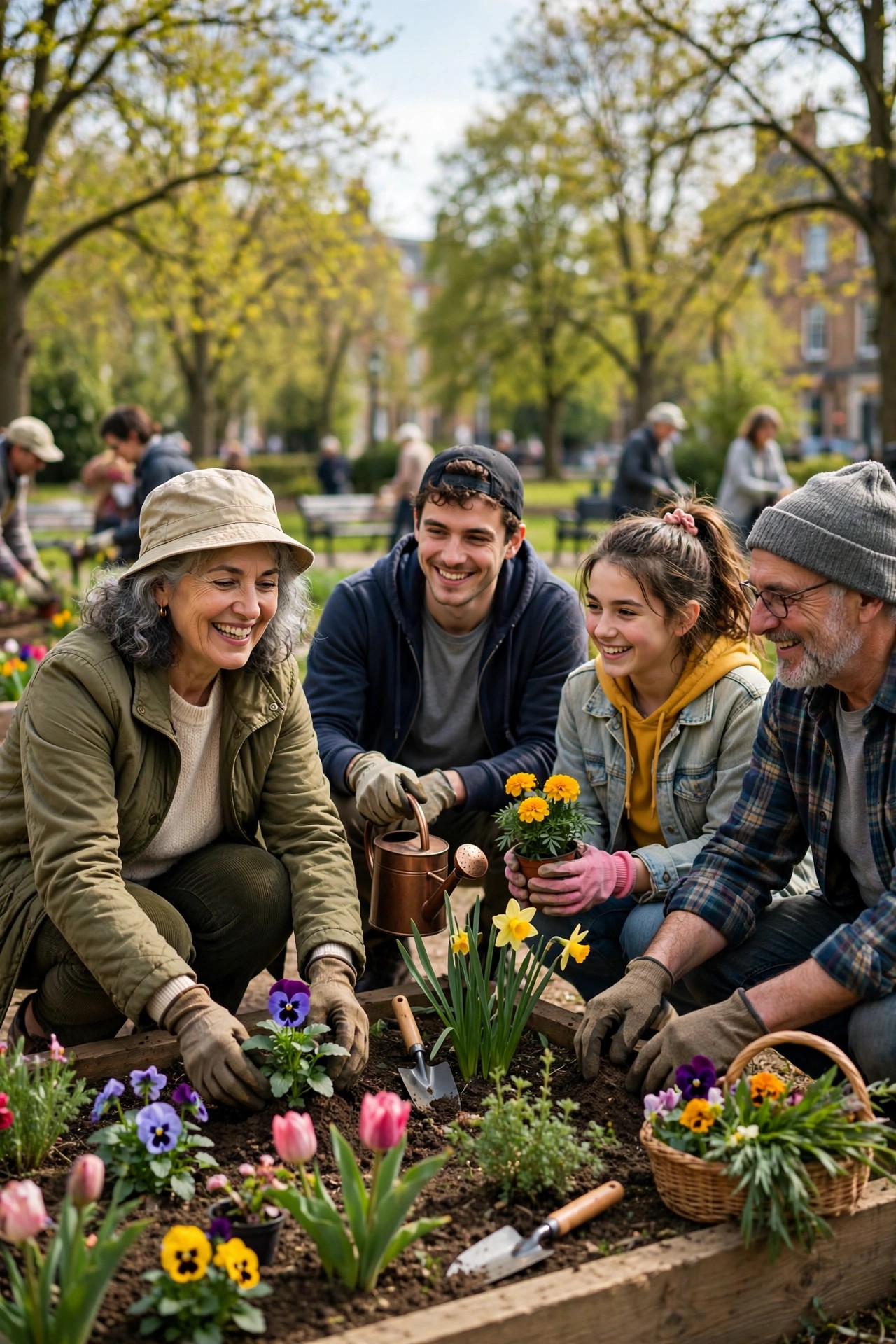
Gloves on, trowel in hand, working shoulder to shoulder with other volunteers — town cleanup days and planting mornings are friendship machines. The work gives everyone something to do, the breaks give everyone someone to talk to, and you leave knowing you made the town itself a little lovelier.
Try this: Sign up through the town website or community board; they always need more hands, and they mean it.
Budget tip: Tools and gloves are usually provided — just bring water and sunscreen.
12. 🎓 Enroll in one adult-education class

Community colleges and rec centers run daytime and evening courses in everything from pottery to Spanish to local history. You’ll sit beside the same people for six or eight weeks — exactly the repetition window where acquaintances quietly become friends.
Try this: Pick the subject that genuinely excites you, not the one that seems “useful.” Enthusiasm is magnetic.

Make it yours: Sit in the same spot each week. Familiar faces find each other.
13. 🛒 Become known at the corner shop

The greengrocer, the bakery, the little hardware store — small shops are the living rooms of a town. Learn the owner’s name, ask what’s good this week, become the woman who always stops to chat. Shopkeepers know everyone, and a shopkeeper who likes you will introduce you to half the town.
Try this: Ask for a recommendation every visit: “What’s good today?” It’s the smallest conversation, and it always works.
Make it yours: Visit at quieter times — mid-morning, mid-afternoon — when there’s actually time to talk.
14. 🃏 Find the card table at the senior center

Almost every senior center has a standing card game, a mahjong table, or a puzzle corner where the same group gathers weekly. You don’t need to be good — you need to be willing. “Teach me?” is one of the most disarming sentences in the English language.
Try this: Call ahead and ask when beginners are welcome. Then just show up with a smile.
Avoid: Worrying about winning. Nobody remembers who won; everyone remembers who was fun.
Ask for help, not just company. “I’m new here — where do you get your hair cut?” or “Which dentist do you like?” is the easiest conversation starter ever invented. People love being the local expert, and asking for advice flatters them while giving you a natural reason to keep talking. The newcomer who asks questions makes friends faster than the newcomer who tries to impress.
15. 🏠 Host a “new in town” coffee morning

Here’s a secret: you’re not the only newcomer. Invite the neighbors you’ve met — plus anyone the online group or newcomers club mentions — for a simple Saturday coffee morning. Hosting puts you at the center of the circle, and fellow newcomers are the most friendship-ready people in town.
Try this: Keep it to two hours; paper cups are fine and store-bought pastries are perfect. Done beats fancy.
Make it yours: Invite one “old-timer” neighbor too — they love being asked, and they know everything.
16. 🚶 Ask one neighbor for a 20-minute walk

Walking side by side is the easiest conversation format ever invented — no eye contact required, pauses feel natural, the scenery does half the talking. One specific invitation (“Would you like a short walk Thursday morning?”) beats a hundred vague “we should get together sometime” promises.
Try this: Suggest a short, specific route and time. Specific is easy to say yes to.
Avoid: Proposing a marathon — twenty minutes leaves everyone wanting more.
17. 🎨 Go to a gallery opening or “first Friday”

Many towns have a monthly art walk, gallery opening night, or “first Friday” when shops stay open late. The art gives everyone something to look at and talk about, the atmosphere is festive, and “What do you think of this one?” works on absolutely anyone.
Try this: Go alone on purpose. Solo visitors get approached; couples get left alone.
Make it yours: If your town doesn’t have one, the library or community center bulletin board will list the next best thing.
18. 🤝 Volunteer for a cause you already loved

Animal shelter, food bank, literacy program, hospital auxiliary — if you volunteered for or cared about a cause before the move, find its local version now. You’ll skip the awkward getting-to-know-you phase because you already share values with everyone in the room.
Try this: Start with a single shift or orientation. Low commitment, high warmth.
Budget tip: Volunteering is free — and many organizations feed their volunteers surprisingly well.
19. 👋 Find your town’s newcomers club

Many towns — especially popular retirement destinations — have an actual Newcomers Club with monthly coffees, interest groups, and outings designed for people exactly like you. It’s the single highest-leverage social move a new arrival can make: a whole room of people who also don’t know anyone yet.
Try this: Search “[your town] newcomers club” or ask at the library. Then go to the very next coffee.
Make it yours: Join one interest subgroup right away — book club, lunch bunch, hiking — that’s where the real friendships form.
20. 🍲 Carry a dish across the lawn

Food has ended more neighborly awkwardness than any words ever could. A still-warm casserole, a batch of muffins, a pot of soup carried across the lawn to a neighbor — especially one who’s been kind, or one who lives alone — says “I see you” in a way nothing else does.
Try this: Double whatever you’re already cooking tonight. The second portion is a friendship waiting to happen.
Avoid: Waiting for a “good reason.” Tuesday is a perfectly good reason.
21. 💬 Master the 30-second hello

You don’t need sparkling small talk — you need one warm, repeatable greeting. “Hi, I’m ___, I just moved in on Maple Street — how long have you lived here?” Thirty seconds, a genuine smile, then listen. Most conversations that become friendships started with something this simple.
Try this: Practice your line out loud once, in the mirror. It feels silly; it works beautifully.
Make it yours: End with a question, always. Questions keep doors open.
22. 🌅 Give every new face the “three hellos” rule

Here’s the quiet magic behind every friendship on this list: greet the same person three times and they’re no longer a stranger. The barista, the neighbor, the woman from tai chi — hello once is polite, twice is familiar, three times is the beginning of something real.
Try this: Pick three “regulars” in your new life and make a point of greeting each by name this week.
Make it yours: Learn names fast and use them. Nothing says “you matter to me” like a remembered name.
Starting over socially in a new town is brave — braver than most people realize. Some weeks you’ll feel like yourself, chatting easily; other weeks the loneliness will surprise you at the grocery store. Both are normal. You are not behind, you are not “bad at this,” you are simply beginning. Every hello counts — even the awkward ones. Especially the awkward ones.
❓ New Town, New Friends FAQs
I’m shy and terrible at small talk. Can I really do this?
Yes — and here’s why: the ideas above barely require small talk at all. Activity-based hellos (classes, volunteering, walking beside someone) let conversation grow sideways out of doing things together, instead of face-to-face chatter. Start with the lowest-pressure ones — the mailbox note, the café routine, the library — and let confidence build one small yes at a time. Most newcomers feel exactly as nervous as you do.
Everyone here seems to already have their friend groups. Is it too late for me?
It’s never too late — that “everyone already has friends” feeling is an illusion almost every newcomer experiences. In reality, most adults quietly wish for one or two more genuine friends, and established groups are often more welcoming than they look from the outside. Newcomers clubs exist precisely because so many people are in your shoes. Someone has to say hello first, and there’s no rule it can’t be you.
How long does it take before a new town actually feels like home?
Honestly? Most people say six months to a year before a new place starts feeling like home — and the timeline shrinks dramatically once you have three or four familiar faces. That’s why repetition matters more than intensity: a weekly class or a regular café visit builds belonging far faster than one big social push. Be patient with the in-between months; they’re normal, not a sign you made a mistake.
What if I go to something and nobody talks to me?
It happens, and it stings — but it says nothing about you. Established groups can be unintentionally cliquey, and one quiet visit proves nothing. Try arriving a few minutes early next time (early arrivers always chat), position yourself near the greeter or instructor, and ask one simple question. If a group still feels cold after three visits, bless it and move on — warmth is out there, I promise.
I moved to be near my children or grandchildren. Why do I still feel lonely?
Because family love and friendship are different hungers, and one can’t fully feed the other. Your children have their own busy lives, and the daily texture of casual friendship — the coffee dates, the shared jokes, the people who notice your absence — has to be rebuilt from scratch. Wanting friends of your own isn’t disloyal to your family; it’s one of the healthiest things you can do for yourself, and for them.
🏡 Home Isn’t a Place — It’s People Who Know Your Name
Here’s what the moving boxes don’t tell you: a house becomes a home the moment someone in town knows your name — the barista who starts your order when she sees you, the neighbor who waves from the driveway, the woman from the newcomers club who saves you a seat. You don’t need dozens of friends. You need a handful of familiar faces, and a few regular places where yours is familiar too.
Start with one idea from this list. Just one — the knock, the note, the café, the walk. Small hellos have a way of compounding into a life that feels warm and rooted again. You were brave enough to start over in a new town; you’re brave enough for the hellos too. Your people are here — go and find each other.
📖 Keep Reading
- 🤗 Make New Friends After 60: 20 Gentle Ways That Actually Work — Once the first hellos are done, here’s how to turn friendly faces into real, lasting friendships.
- 🌍 How to Live Abroad in Retirement: 25 Things to Know Before You Move — Thinking even bigger? What to know before making a move across borders in retirement.
- 🎨 Retirement Hobbies for Women: 22 Ideas for Joy and Friends — Fill your new-town calendar with hobbies that double as friendship-makers.
Discover more from Fashinate Style
Subscribe to get the latest posts sent to your email.