
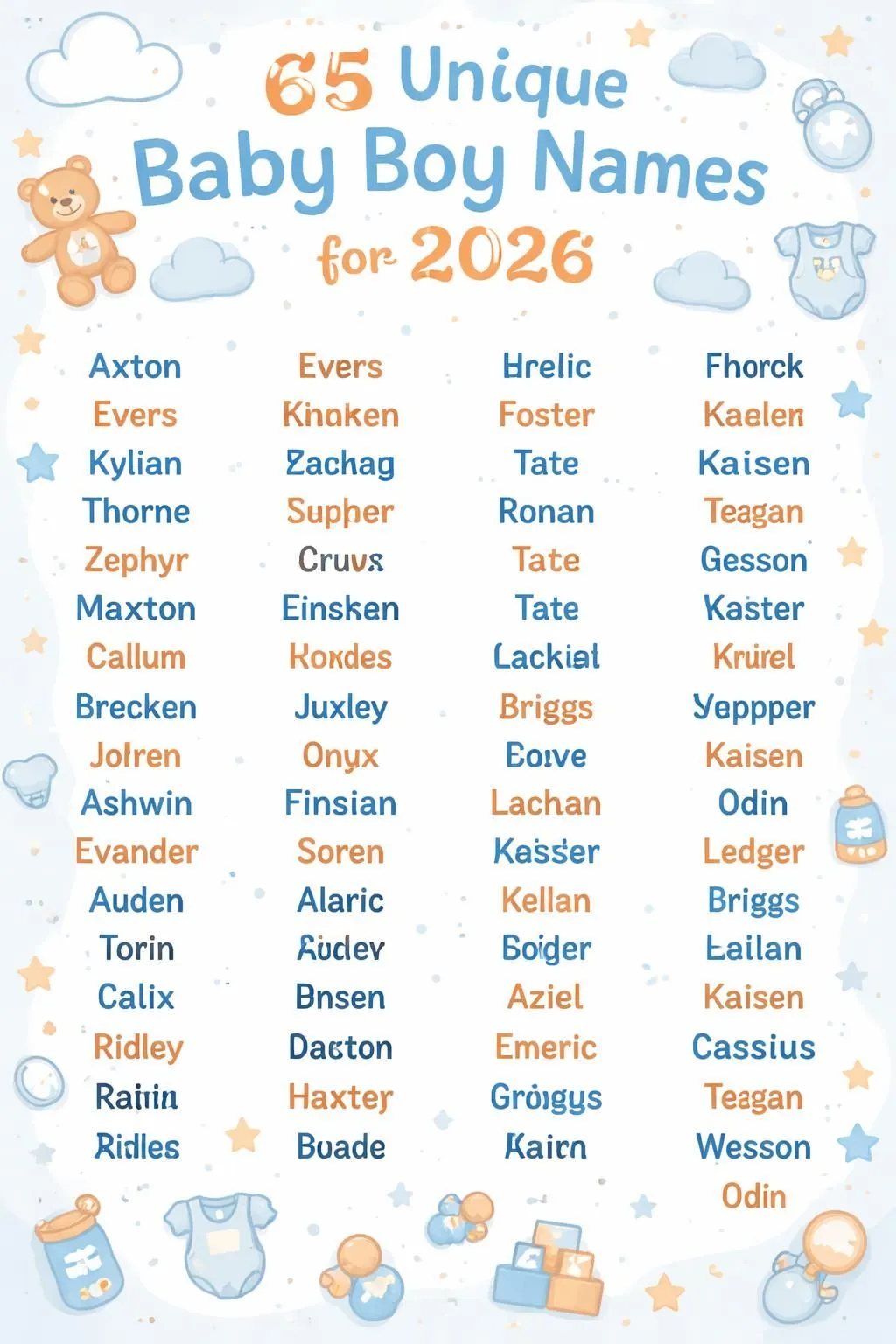
There is something quietly powerful about giving a child a name that belongs entirely to him. Not a name borrowed from the top of a popularity chart. Not a name shouted across five different soccer fields at once. A name with roots, with meaning, with a story worth telling — one that fits him before he's even born and grows with him through every stage of his life.
In 2026, baby naming is going through a genuine shift. Parents are moving away from the decade-long dominance of names like Liam, Noah, and Oliver — not because those names aren't beautiful, but because they want something that feels more personal. More intentional. The names rising in quiet popularity right now draw from mythology, ancient history, literature, nature, and global cultures. They are rare without being invented. Distinctive without being difficult. And every single one of them has earned its place on this list.
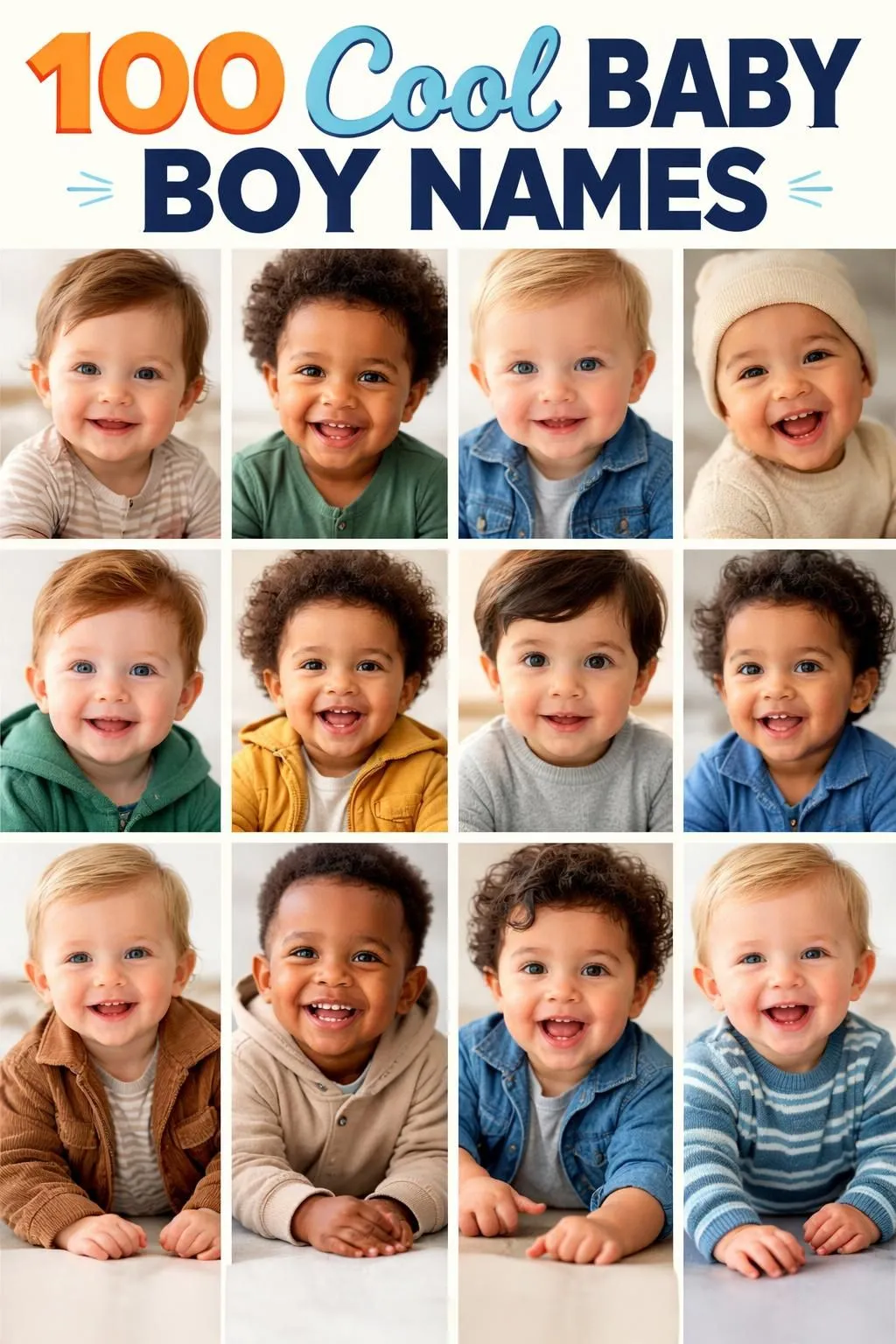
These are 65 unique baby boy names for 2026 that no one else is using — and exactly why each one deserves to be heard.
Why Parents Are Choosing Rare Names in 2026
The data tells an interesting story. While the top ten boy names in the United States have barely shifted in years, the names making the fastest climbs are overwhelmingly rooted in mythology, vintage revival, and the natural world. Parents are choosing names that feel calm yet confident, bold yet beautifully soft. They want names that work on a baby and still sound right in a boardroom thirty years later. They want names with staying power — names that are old enough to feel timeless but rare enough to feel like a discovery.
A truly rare name is not a made-up combination of trendy syllables. It is a name that has existed for centuries, carried by warriors and poets and kings, waiting patiently to be rediscovered by exactly the right family.
Subscribe to our Newsletter
Get the latest articles and news delivered to your inbox.
Rare Vintage Boy Names Making a Quiet Return
Some of the most compelling names of 2026 are names that were once widely used, then fell completely out of fashion for a generation or two, and are now ready to be reclaimed. They carry the weight of history without feeling old-fashioned — because genuinely great names never really age.
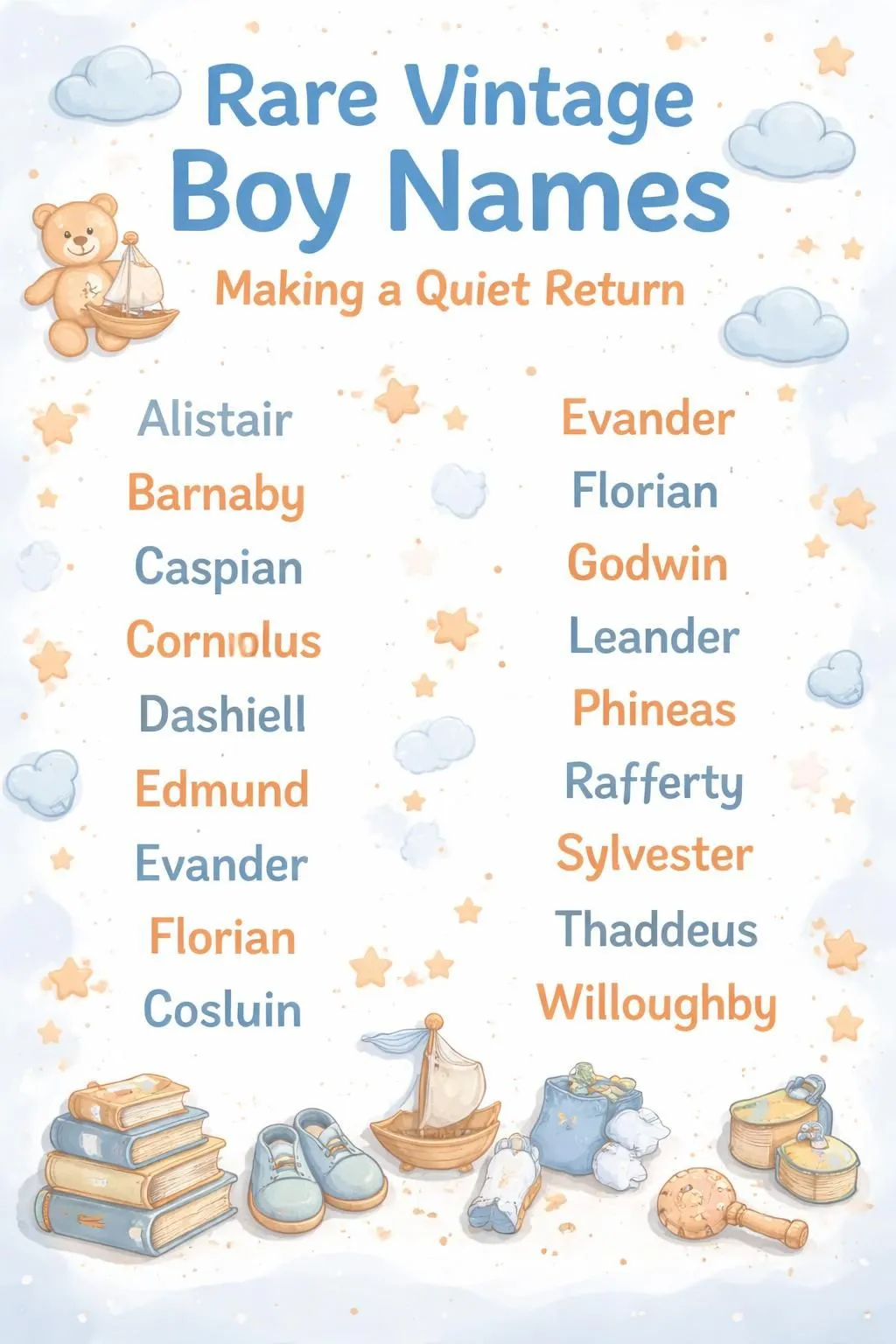
Alistair is the Scottish form of Alexander, meaning "defender of men." It has an aristocratic, literary quality that feels both strong and refined — far more distinctive than its more common cousin.
Barnaby is an English name of Hebrew origin meaning "son of consolation." Used by Dickens, associated with quiet English charm, and almost completely unused today. The nickname Barney adds a warm, approachable touch.
Caspian has literary roots in C.S. Lewis's Chronicles of Narnia and carries an adventurous, seafaring quality. It is rare enough to feel genuinely original while sounding instantly wearable.
Cornelius is a Roman family name meaning "horn" — associated with strength and endurance. It was common in the 19th century and has been dormant long enough to feel entirely fresh again.
Dashiell has French and English origins and was made famous by hard-boiled novelist Dashiell Hammett. It has a cool, literary swagger that is completely its own.
Edmund is an Old English name meaning "wealthy protector." It appears in Shakespeare, C.S. Lewis, and King Lear, and carries a quiet nobility that far outshines its current obscurity.
Evander comes from Greek and Scottish mythology — the son of Hermes and a legendary king in Roman history. Strong, melodic, and almost completely unused in modern nurseries.
Florian is a Latin name meaning "flowering" or "flourishing." Common in Central Europe, nearly unknown in the English-speaking world, and remarkably beautiful to say aloud.
Godwin is an Old English name meaning "friend of God." Unusual and bold, it has an ancient English solidity that feels surprisingly wearable.
Leander is Greek mythology's greatest romantic hero — the young man who swam the Hellespont every night to reach his beloved Hero. As a name it is lyrical, strong, and deeply rare.
Phineas is a Hebrew name of ancient origin, meaning "oracle" or "Nubian." It was common in early American history and has a playful, intellectual energy that suits a curious, creative child.
Rafferty is an Irish surname name meaning "one who prospers" with an easygoing, creative charm that feels both distinctive and completely approachable.
Sylvester is a Latin name meaning "of the forest." Old Hollywood associations, a strong sound, and genuine rarity make this one of the most undervalued vintage names available.
Thaddeus is an Aramaic name meaning "heart" or "courageous heart." The nickname Thad is cool and clean, while the full name carries remarkable gravitas.
Willoughby is an English place-name turned surname turned first name — rare, literary, and carrying the kind of quiet distinction that makes people pause and ask where it came from.
Mythological and Historical Boy Names
For parents drawn to names with epic depth — names that carry the weight of gods, heroes, and ancient civilisations — these are the picks that deliver.
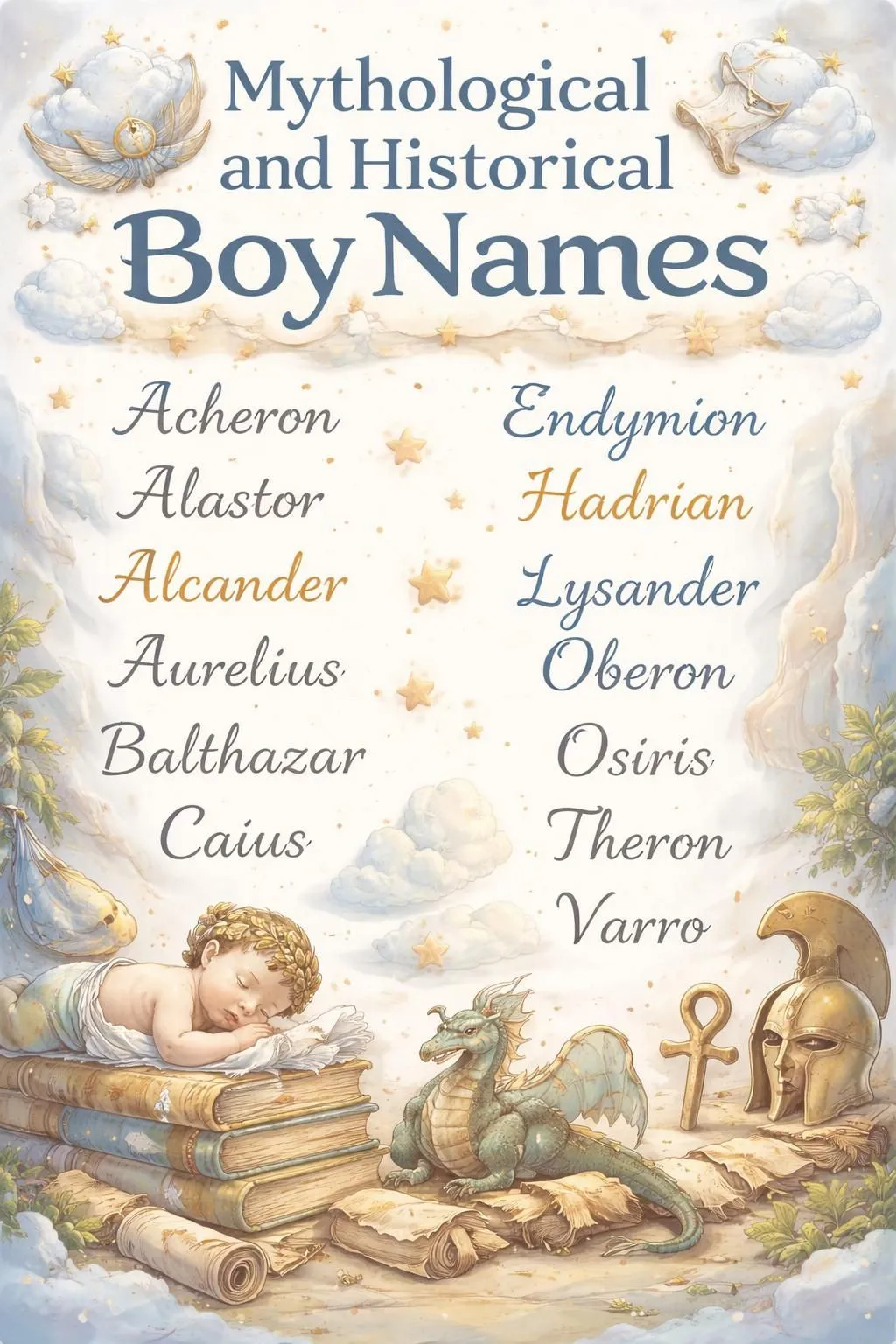
Acheron is a river of the underworld in Greek mythology. Dark, unusual, and hauntingly beautiful as a name for a boy who will carry his own mythology.
Alastor is an epithet of Zeus in Greek mythology, meaning "avenger." Powerful, unusual, and already making quiet appearances among parents who love fantasy literature.
Alcander is an ancient Greek name meaning "strong man." A genuine rarity that sounds like it belongs alongside Evander and Leander in the best possible way.
Aurelius is a Roman imperial name meaning "golden." It has the distinction of being both ancient and completely modern — equally at home in the Roman Empire and a 2026 nursery.
Balthazar is the traditional name given to one of the three Magi and has Persian and Babylonian roots. Grand, unusual, and carrying both spiritual and adventurous energy.
Caius is a Roman praenomen of uncertain but ancient origin — worn by Julius Caesar and countless Roman statesmen. Short, striking, and remarkably rare in modern use.
Endymion is the beautiful shepherd of Greek mythology loved by the moon goddess Selene. Long and lyrical, it suits parents who want a name with genuine celestial romance.
Hadrian is the Roman emperor who built the famous wall across northern Britain. Strong, historical, and far more interesting than the more common Adrian from which it differs by a single letter.
Lysander is a Spartan naval commander and a character in A Midsummer Night's Dream. It has a romantic, Shakespearean quality and rolls off the tongue with remarkable elegance.
Oberon is the king of the fairies in A Midsummer Night's Dream and an ancient Germanic name meaning "noble bear." Magical, literary, and entirely its own.
Osiris is the Egyptian god of the afterlife, resurrection, and agriculture. Bold and mythological, it suits parents who want a name that carries ancient power and genuine rarity.
Theron is an ancient Greek name meaning "hunter." Used by fewer than 100 babies per year in the US, it is distinctive without being difficult — a name that sounds right immediately.
Varro is a Roman name borne by one of Rome's greatest scholars. Brief, strong, and carrying a classical confidence that is hard to replicate.
Nature-Inspired Rare Boy Names
The natural world continues to inspire some of the most beautiful and underused names available. These go far beyond the surface-level Hunters and Rivers of recent years into genuinely surprising territory.
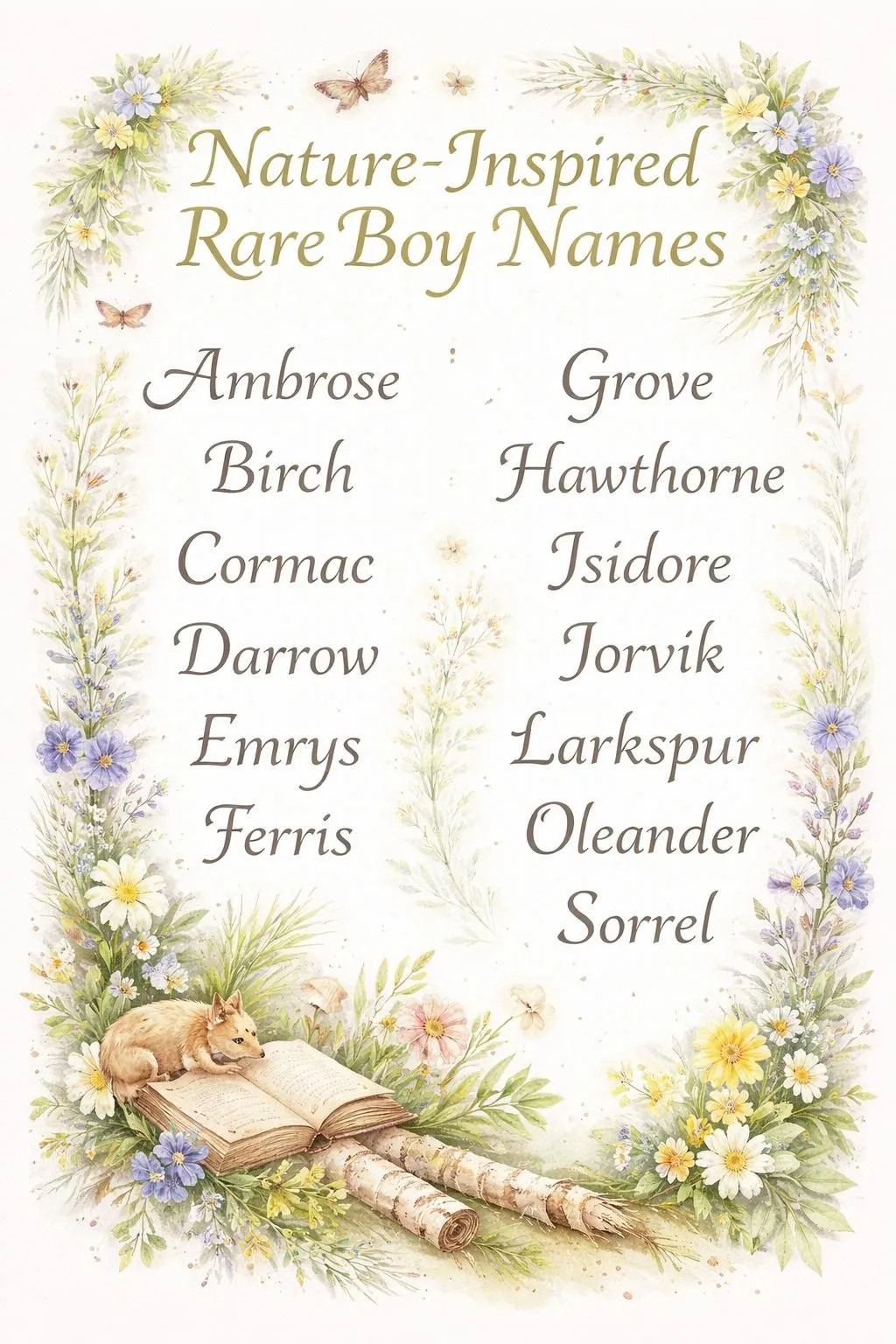
Ambrose means "immortal" in Greek and was the name of a fourth-century bishop whose name became synonymous with something divine and sweet — ambrosia, the food of the gods.
Birch is a tree name so rare it barely registers on naming charts, yet it has a crisp, clean sound that feels modern and grounded at the same time.
Cormac is an ancient Irish name meaning "son of the chariot" or "raven's son." Earthy, Celtic, and deeply rare outside of Ireland — and increasingly noticed by parents drawn to Irish heritage names.
Darrow is an English nature name meaning "oak tree." Strong, simple, and carrying a quiet dignity that feels completely original.
Emrys is a Welsh name of Greek origin meaning "immortal." It has ties to Merlin's legendary birth name in Welsh mythology and a soft, musical quality that is entirely unique.
Ferris has Irish origins meaning "rock" and a bright, energetic sound that makes it immediately likeable. Far rarer than its similar-sounding cousins Fergus and Felix.
Grove is a pure word name — simple, natural, and extraordinarily rare as a given name. For parents who want nature in one syllable.
Hawthorne is a flowering tree name with literary associations to Nathaniel Hawthorne. It has a wild, romantic quality and the easy nickname Haw or Thorn for those who want options.
Isidore is a Greek name meaning "gift of Isis." Associated with scholarship and wisdom, it has a warm, old-world sound that is completely unexpected in a modern nursery.
Jorvik is the ancient Viking name for the city of York in England. Bold, historical, and carrying a Norse ruggedness that is impossible to ignore.
Larkspur is a wildflower name of breathtaking beauty — almost exclusively used for girls but carrying no reason it cannot belong to a boy with the confidence to wear it.
Oleander is a Mediterranean flowering shrub with a striking, unusual name that carries both beauty and a quiet edge. Rarely used and instantly memorable.
Sorrel appears again here as a genuinely unisex name — the warm reddish-brown of autumn and the taste of a sharp, clean herb. Completely unexpected on a boy and completely wonderful.
Literary and Artistic Rare Boy Names
For the readers, the writers, and the lovers of art — names pulled from the pages and canvases that have shaped the world.
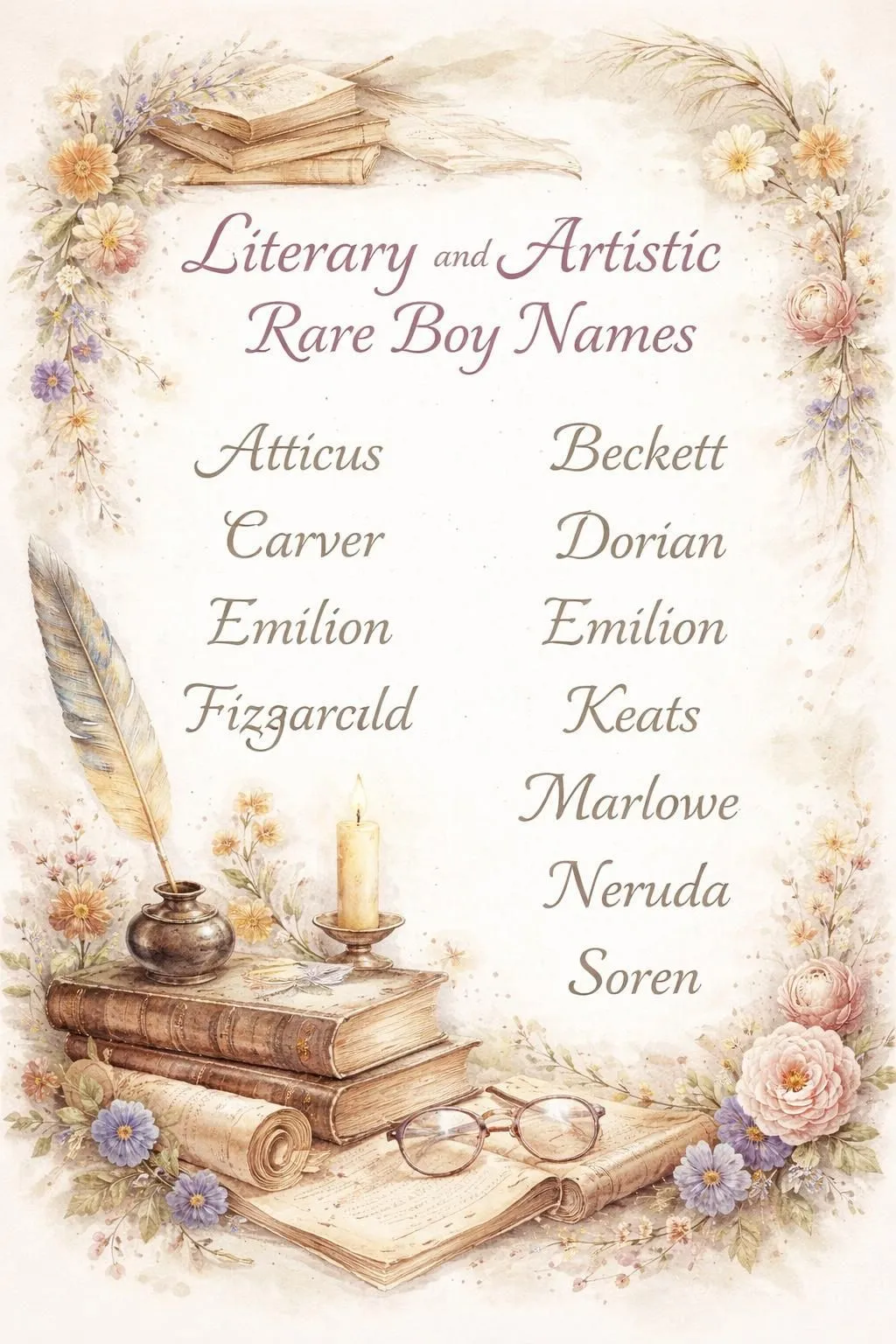
Atticus has risen slightly in recent years thanks to To Kill a Mockingbird, but remains genuinely rare. It carries a moral weight and quiet dignity that makes it one of the most meaningful names in English literature.
Beckett has a literary edge through Samuel Beckett and a contemporary cool through its crisp sound. Poetic, modern, and quietly climbing without yet becoming overexposed.
Carver references short-story master Raymond Carver and has a strong, crafted quality — the name of someone who makes things carefully and well.
Dorian is Oscar Wilde's immortal creation — beautiful, literary, and slightly dangerous. It has a dark romantic quality that suits parents who love names with artistic shadows.
Emilion is a French name with artistic and geographic resonance — the wine region Saint-Émilion gives it a refined, European quality that is entirely distinctive.
Fitzgerald is the great American literary surname turned first name — carrying F. Scott Fitzgerald's Jazz Age glamour in one long, confident sweep of syllables.
Keats is the Romantic poet whose short life produced some of the most beautiful verse in the English language. As a name it is brief, strong, and unmistakably artistic.
Marlowe is a Christopher Marlowe reference but also a modern surname name with a cool, unisex quality that has been quietly gaining attention without yet breaking through.
Neruda is the Chilean Nobel laureate whose love poetry is among the most celebrated in the world. Bold, romantic, and carrying a passion that is impossible to ignore.
Søren is the Scandinavian philosopher Kierkegaard's given name — meaning "stern" in Danish but carrying a poetic, philosophical quality that is gentle rather than severe.
Global and Cross-Cultural Rare Boy Names
Some of the world's most beautiful boy names simply haven't crossed over into mainstream English-language use yet. These are names from other languages and cultures that deserve a wider audience.
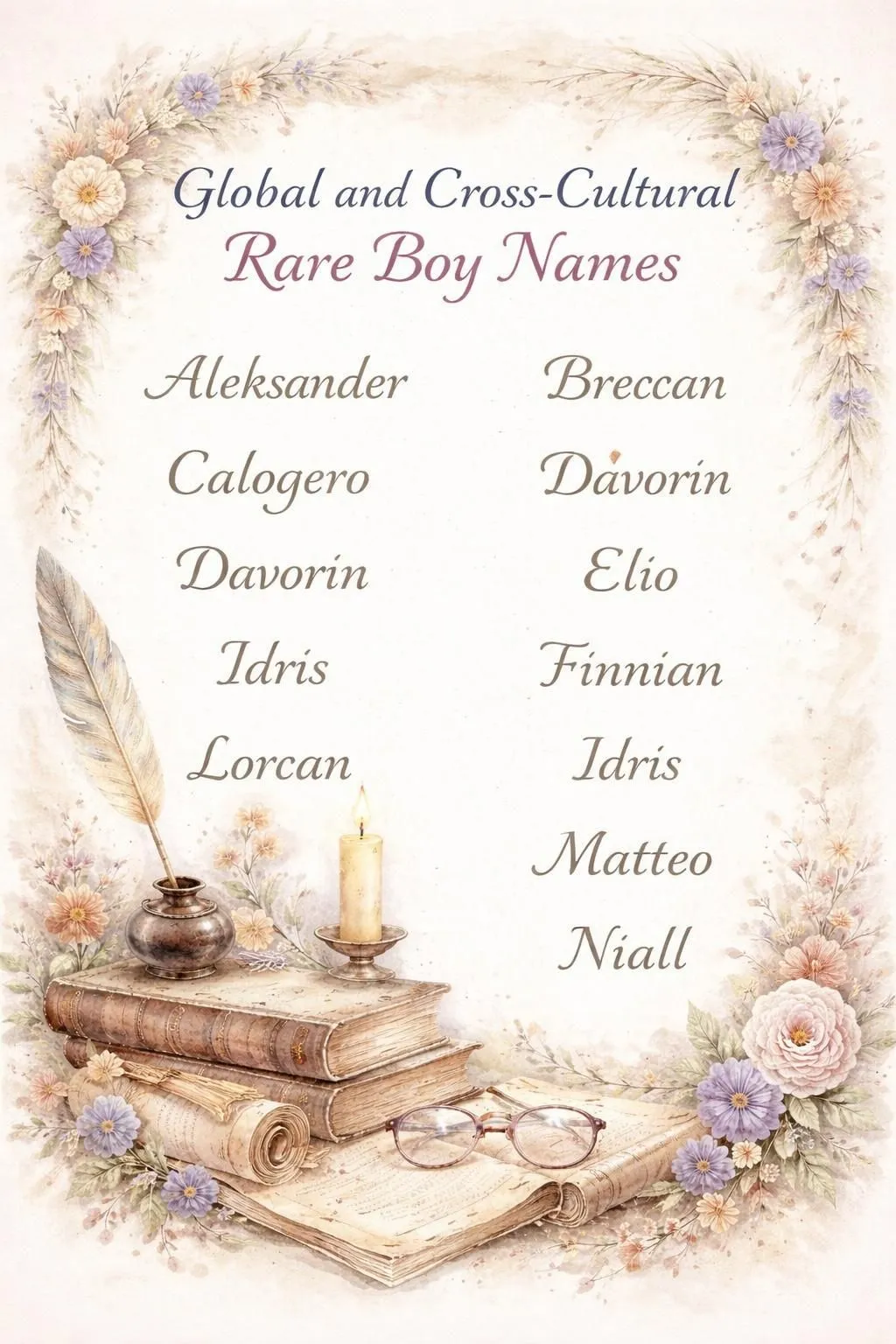
Aleksander (Scandinavian/Eastern European) is the form of Alexander used across northern and eastern Europe. Slightly more distinctive than the standard spelling without being difficult.
Breccan is an Irish name meaning "freckled" — carried by an early Irish saint and completely unused in modern naming. It has a warm, Celtic energy and the easy nickname Breck.
Calogero is a Sicilian name of Greek origin meaning "beautiful elder." Unusual in English-speaking countries, it carries an Italian warmth and an unexpected, memorable sound.
Davorin is a South Slavic name derived from the god of war in Slavic mythology. Bold, unusual, and carrying a cultural depth that is entirely its own.
Elio is an Italian and Spanish name meaning "sun." It has been quietly climbing and remains genuinely rare — warm, bright, and easy to wear in any language.
Finnian is an ancient Irish name meaning "fair" — the name of several early Irish saints. More distinctive than Finn or Finnian's more common variants, and deeply rooted in Celtic tradition.
Idris is a Welsh name meaning "ardent lord" and also an Islamic prophet figure. It has Welsh, Arabic, and African cultural connections and a clean, strong sound that works beautifully in any context.
Lorcan is an old Irish name meaning "little fierce one" — carried by a high king of Ireland and barely used outside of the island. It has a fire and energy that its meaning perfectly captures.
Matteo (Italian) is the Italian form of Matthew — softer and more melodic than the English version, it has been rising but remains far less common than its counterpart.
Niall (Irish, pronounced NEEL) is an ancient Irish name meaning "champion." The name of legendary Irish kings and almost entirely unknown outside of Ireland — which makes it a genuinely rare and powerful choice.
Choosing a Name That Will Last a Lifetime
The best rare names share a few qualities. They are easy to say and easy to spell even if they are uncommon. They have a story worth telling. They age from babyhood to adulthood without losing their character. And they feel right the moment you say them aloud — not just clever, not just unusual, but genuinely meant for the child who will carry them.
Say each name you love out loud. Say it the way a teacher would call it across a classroom. Say it the way it will sound at a graduation. Say it the way someone who loves him will say it when he is grown. The name that passes all three tests is the one worth keeping.
The 65 names on this list are rare, meaningful, rooted, and ready. One of them might just be his.



Comments (0)
Leave a Comment