How to Dress for a Bottom-Heavy Body: 17 Stylish Tips to Balance Your Curves
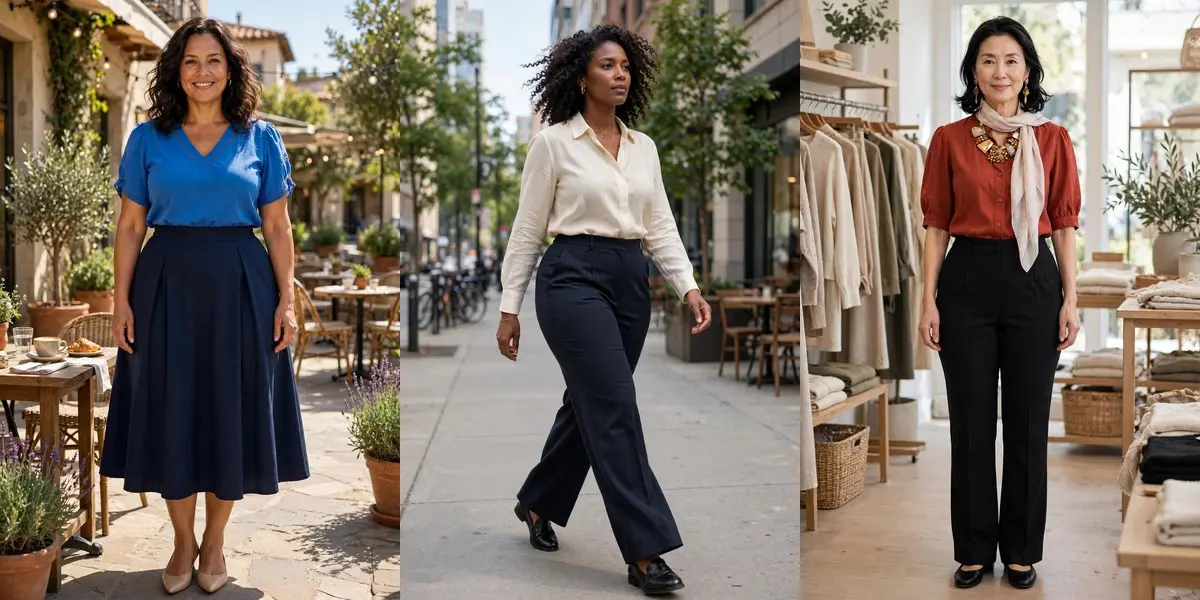
If your hips and thighs are noticeably fuller than your shoulders and bust, getting dressed can feel like a daily negotiation between the two halves of your body. The good news? Learning how to dress for a bottom-heavy body is not about hiding your curves — it is about balance: a little more interest up top, a clear waist, and bottoms that skim instead of squeeze.
A quick shape check: your hips measure wider than your shoulders, your thighs are fuller than your arms, your legs can look a touch shorter than your torso, and your waist may be softer rather than sharply defined. If that sounds familiar, you are in exactly the right place — this shape is common, classic, and genuinely easy to dress well.
Below you will find 17 practical tips: seven that build a balanced outfit from the top down, and ten common traps worth retiring, each with the swap that works instead. For the bigger picture first, our guide to how to dress a bottom heavy body shape walks through the shape itself — then come back here for the everyday rules.
One promise before we start: nothing here asks you to shrink, cover up, or apologize for your proportions. Your curves are the starting point, not the problem. These tips simply arrange color, fabric, and line so the whole outfit looks intentional — and so you feel every bit as good as you look.
As an Amazon Associate, I earn from qualifying purchases.
In This Guide
- 1. Choose Tops That Flatter Your Shape
- 2. Pick Bottoms That Complement Your Curves
- 3. Have Fun With Colors and Patterns
- 4. Pay Attention to Fabrics
- 5. Accessorize Strategically
- 6. Choose Footwear That Elongates
- 7. Confidence Is Your Best Accessory
- 8. Super-Tight Skinny Jeans
- 9. Overly Busy Bottoms
- 10. Very Short Crop Tops
- 11. Extremely Baggy Pants
- 12. Low-Rise Jeans
- 13. Mini Skirts
- 14. Very Stiff Fabrics
- 15. Straight-Cut Dresses
- 16. Horizontal Stripes
- 17. Oversized Statement Belts
- Styling Tips
- Common Mistakes to Avoid
- Wrapping Up: What to Wear With a Bottom-Heavy Body
- Frequently Asked Questions
1. Choose Tops That Flatter Your Shape
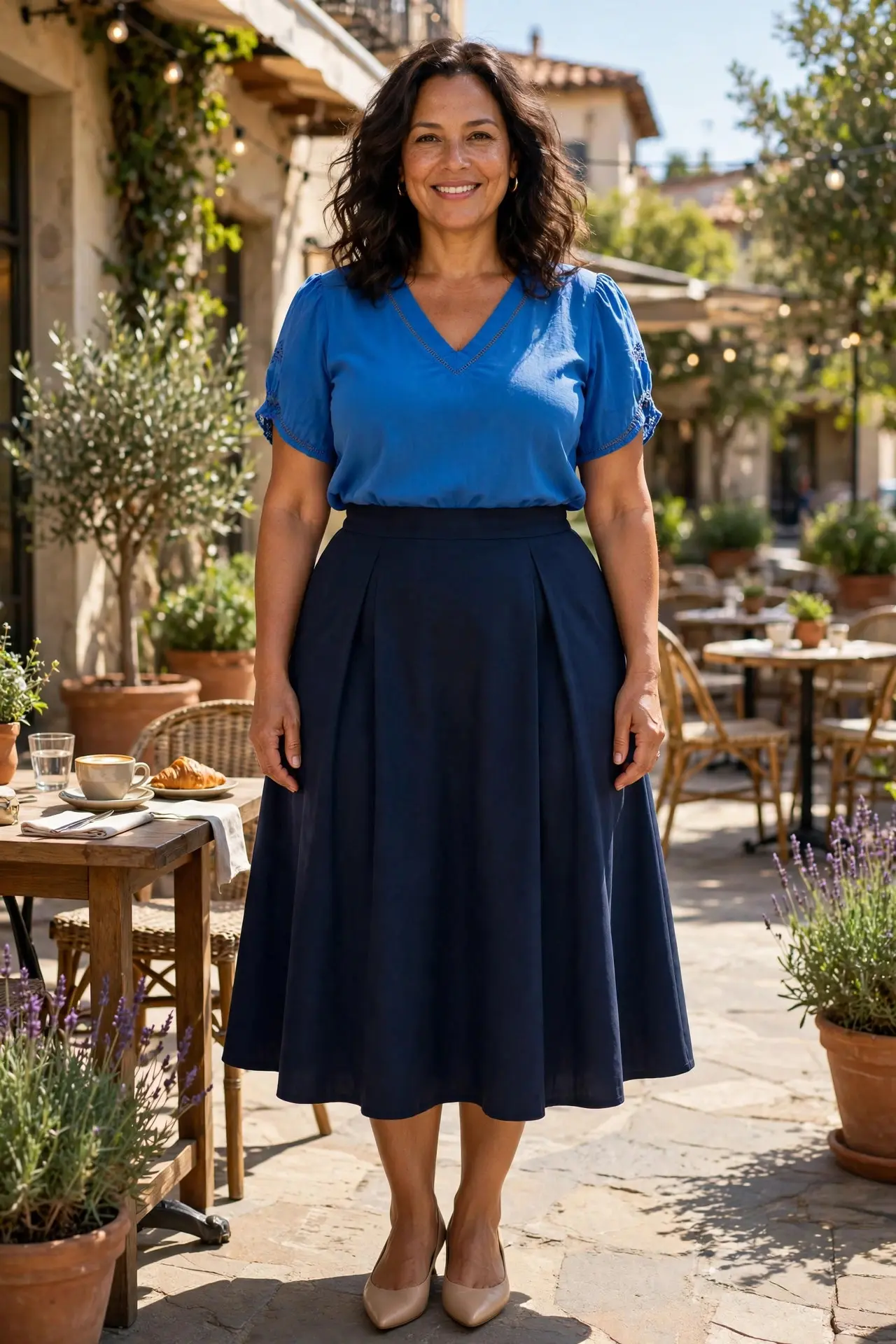
Think of your top half as the billboard of the outfit. When your shoulders and neckline carry the brightest color, the prettiest detail, or a touch of volume, the eye lands there first — and your whole silhouette reads as balanced rather than bottom-led.
Necklines do a lot of this work for free. V-necks and scoop necks open up the chest and lengthen your upper body, while gentle shoulder interest — a puff sleeve, a soft ruffle, a structured seam — adds just enough width up top to meet your hips halfway.
Tip: Tuck your top in, or at least half-tuck it. Showing where your waist sits is what turns a pretty blouse into a proportions strategy, as the cobalt-and-navy pairing above demonstrates.
Shop this look: V-Neck Blouse · Floral Blouse
2. Pick Bottoms That Complement Your Curves
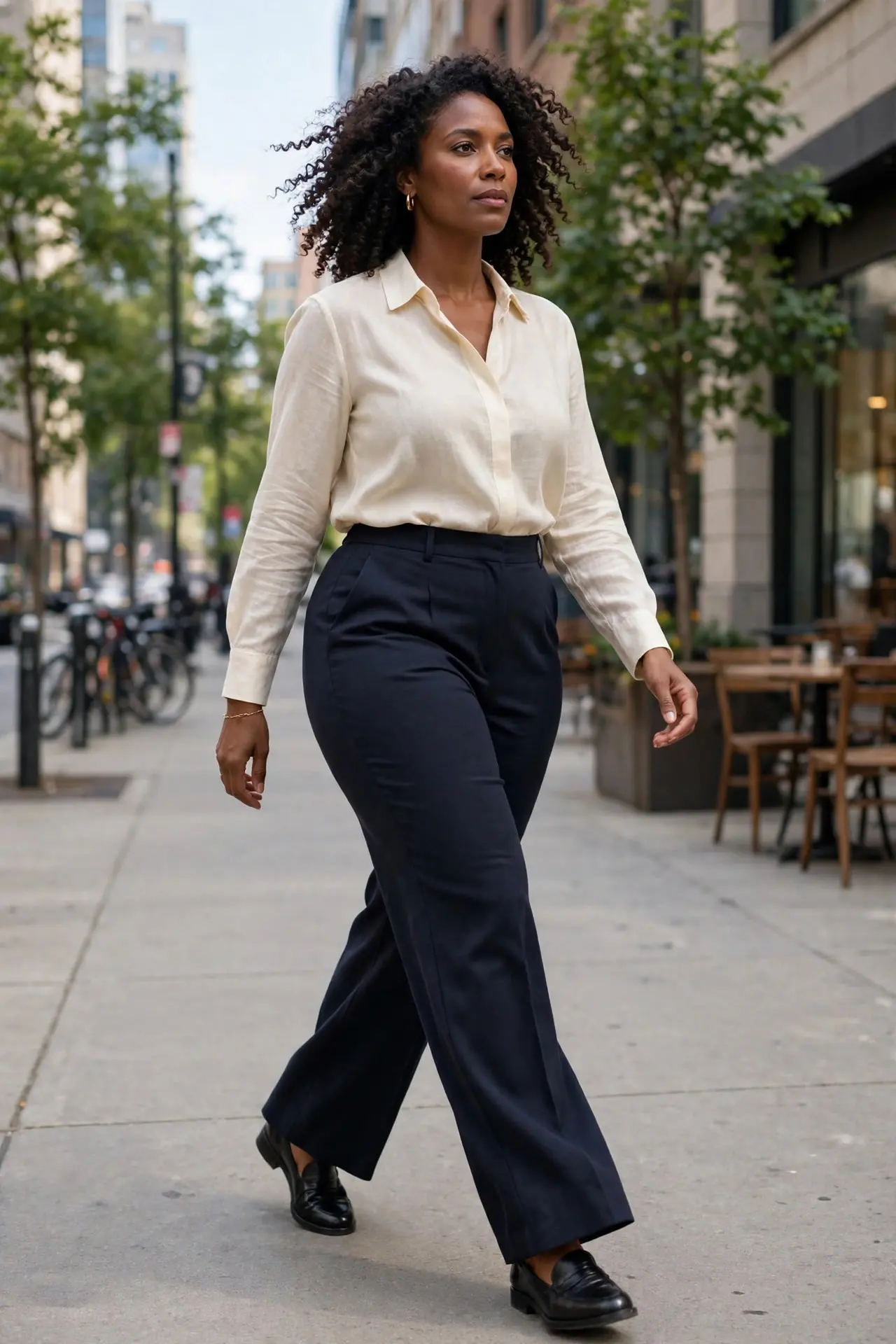
The right bottom does not fight your hips — it glides over them. Look for clean, uncluttered designs in deeper shades like black, navy, charcoal, or deep plum, which visually quieten the lower half and let a lighter top take the spotlight.
A-line skirts and dresses are the classic pear-shape friends because they flare gently from the waist and never cling at the thigh. High-waisted pants earn their place too: the higher rise defines your waist and gives your legs a longer, cleaner line.
Fit note: Fabric should skim as you walk, never pull. If horizontal creases appear across the hip, go up a size and have the waist taken in — that small tailoring step is the difference between squeezing and skimming.
Shop this look: A-Line Skirt · High Waisted Jeans
3. Have Fun With Colors and Patterns
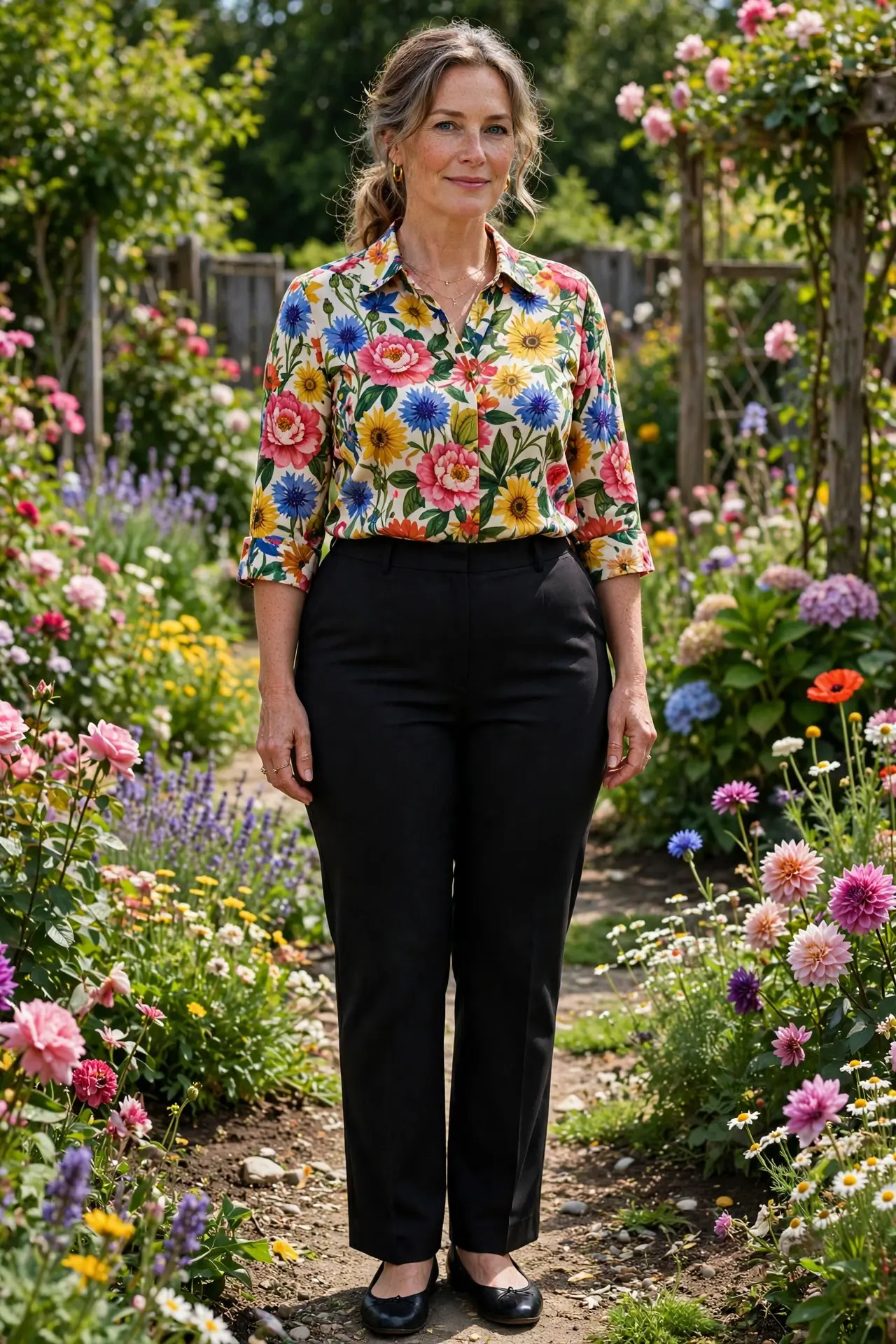
Color placement is a steering wheel for the eye. Put the vivid shades, the joyful prints, and the interesting textures where you want attention — up top — and keep the lower half in calm, solid territory.
A bold floral blouse with plain black trousers, like the outfit pictured here, is the formula at its simplest: all the personality lives above the waist, while the bottoms provide a quiet, streamlined base. Deep solid shades on skirts and pants do the same job on subtler days.
Tip: This is a guideline, not a ban. If a printed bottom calls your name, choose a smaller-scale, darker, low-contrast print — and let the top stay even bolder so the balance still holds.
Shop this look: Teal Silk Blouse · Black Trousers
4. Pay Attention to Fabrics
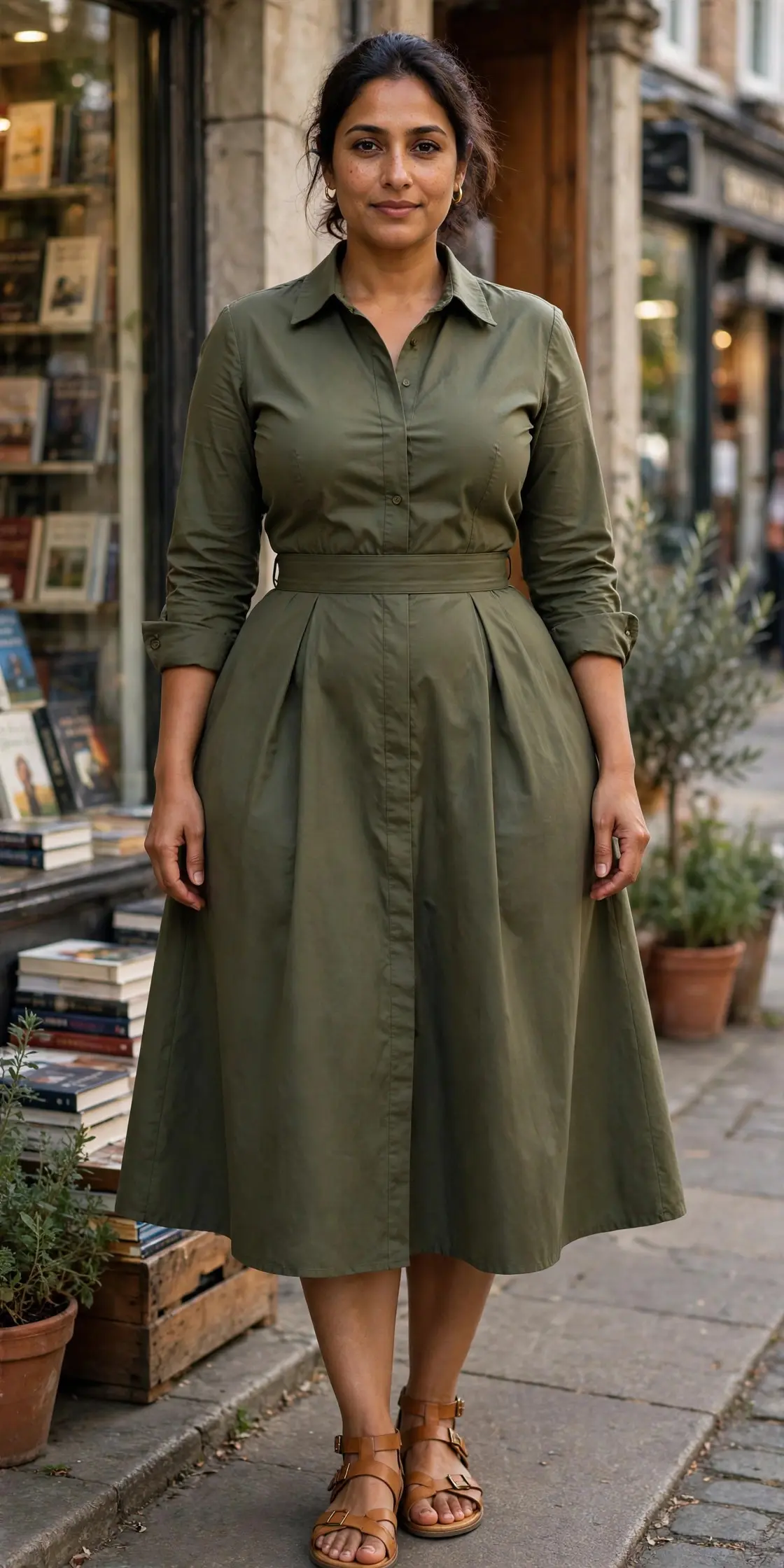
Two identical silhouettes can look completely different depending on the cloth. Fabric decides whether an outfit holds a smooth line over your hips or collapses against them and reports back on every curve.
Fabrics with a little body are your allies: cotton, denim, lightweight wool, and ponte knits hold their shape without feeling stiff, creating that clean, unbroken fall from waist to hem. A structured shirt dress is a perfect example — tailored on top, easy over the hips.
Fit note: Be wary of ultra-thin, clingy jersey across the hip and thigh. A fabric with slight weight and a touch of stretch will always look more expensive — and feel more comfortable — than one that grips.
Shop this look: Ponte Trousers · Shirt Dress
5. Accessorize Strategically
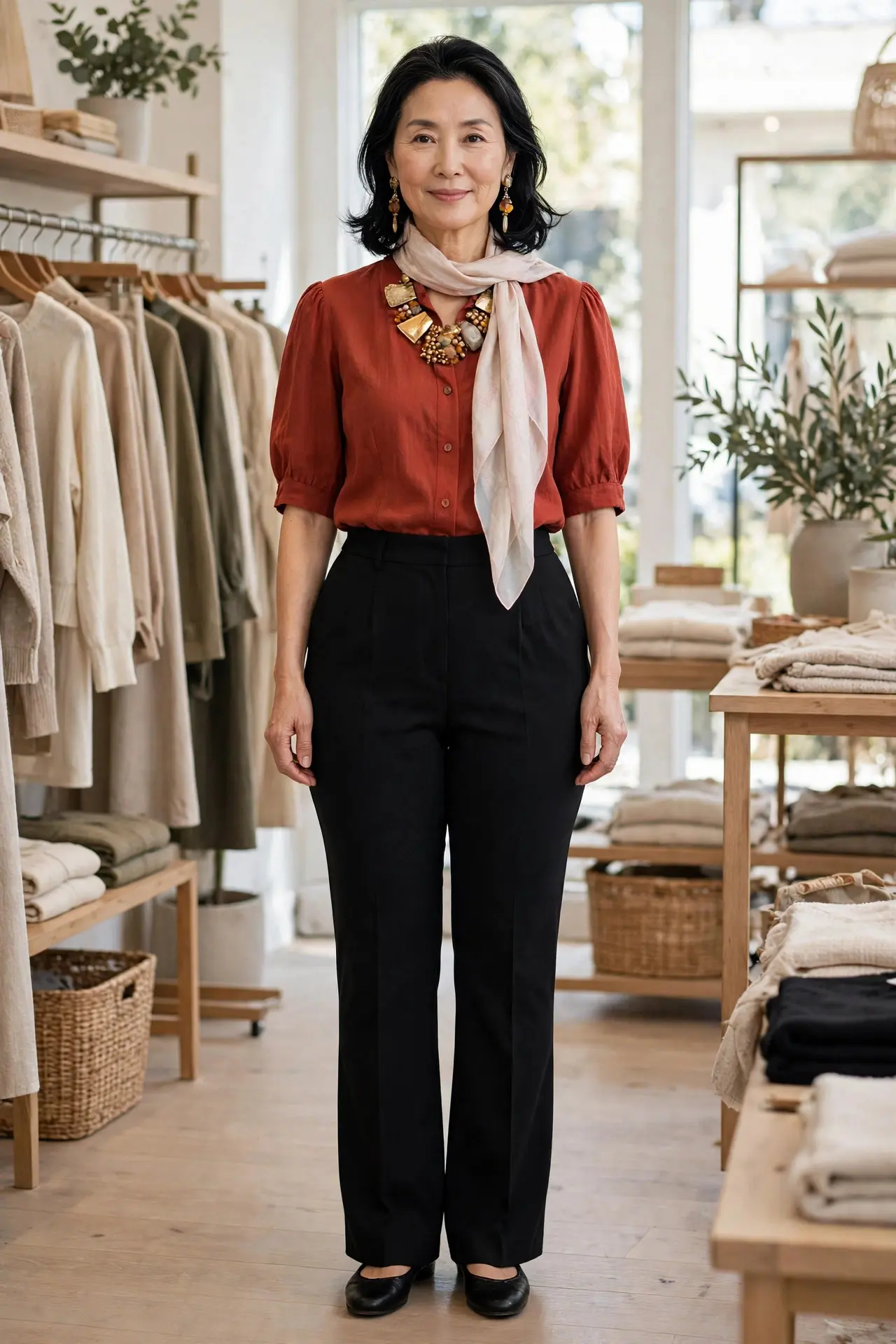
Accessories are attention arrows, and you get to choose where they point. Worn near your face and shoulders, they finish the balancing act your tops started — no complicated styling required.
A statement necklace or a pair of drop earrings frames your face and holds the gaze upward. Scarves and hats work the same magic, adding color and texture exactly where a bottom-heavy figure benefits from a little extra presence. A silk scarf knotted loosely at the neck, like the one in the photo here, delivers the same effect in a softer, more relaxed form.
Tip: Balance the equation by keeping the lower half accessory-quiet: skip embellished pockets, hip-level chains, and heavy ankle details, and let the interest live up top where it flatters you most.
Shop this look: Statement Necklace · Silk Scarf
6. Choose Footwear That Elongates

Shoes finish the leg line, and a few thoughtful choices can add the illusion of inches. You do not need skyscraper heels — even a modest lift changes how a trouser or skirt falls and how long the whole leg appears.
Pointed toes are the quiet heroes here: they extend the visual line of the leg well past where a round or square toe stops it. Pair that pointed shape with a skin-tone or hem-matching shade and the effect doubles.
Tip: With cropped trousers, choose a shoe close to your skin tone; with full-length hems, match the shoe to the trouser color. Either way, the eye travels in one unbroken line from hip to toe.
Shop this look: Pointed Toe Pumps · Pointed Toe Heels
7. Confidence Is Your Best Accessory

Every tip in this guide works twice as well on a woman who stands tall and looks like she is enjoying her clothes. Posture, ease, and a genuine smile change an outfit more than any single styling trick ever could.
So treat these guidelines as a starting wardrobe of ideas, not a rulebook. Try the silhouettes, keep the ones that make you catch your reflection and smile, and retire the rest without a second thought. Fit the body you have today, beautifully.
Tip: Photograph the outfits that earn you compliments and keep a small album on your phone. On low-inspiration mornings, your own greatest-hits collection beats any magazine.
8. Super-Tight Skinny Jeans
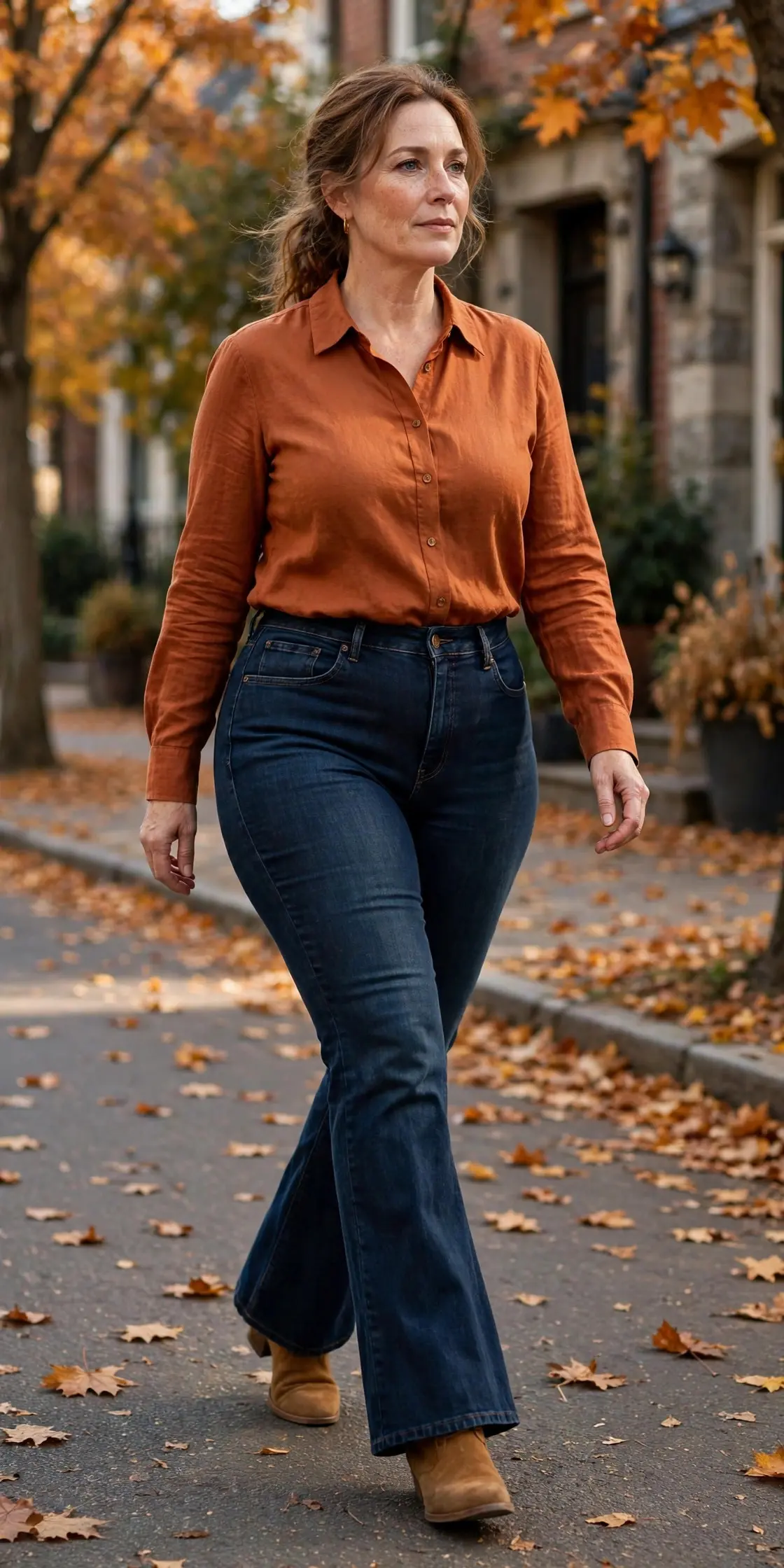
Spray-on skinny jeans trace the hip and thigh like an outline, then stop abruptly at the ankle — which makes the widest part of the leg the main event and the lower half look heavier than it is.
The swap is easy and arguably more comfortable: a straight-leg or bootcut jean in a dark rinse. The slight flare at the hem answers the width at the hip, so the leg reads as one long, balanced line from waist to boot.
Fit note: Whatever the cut, keep a whisper of ease at the thigh. Denim should skim and move with you; if it creases horizontally across the front, it is a size too small, not a style.
Shop this look: Straight Leg Jeans · Bootcut Jeans
9. Overly Busy Bottoms
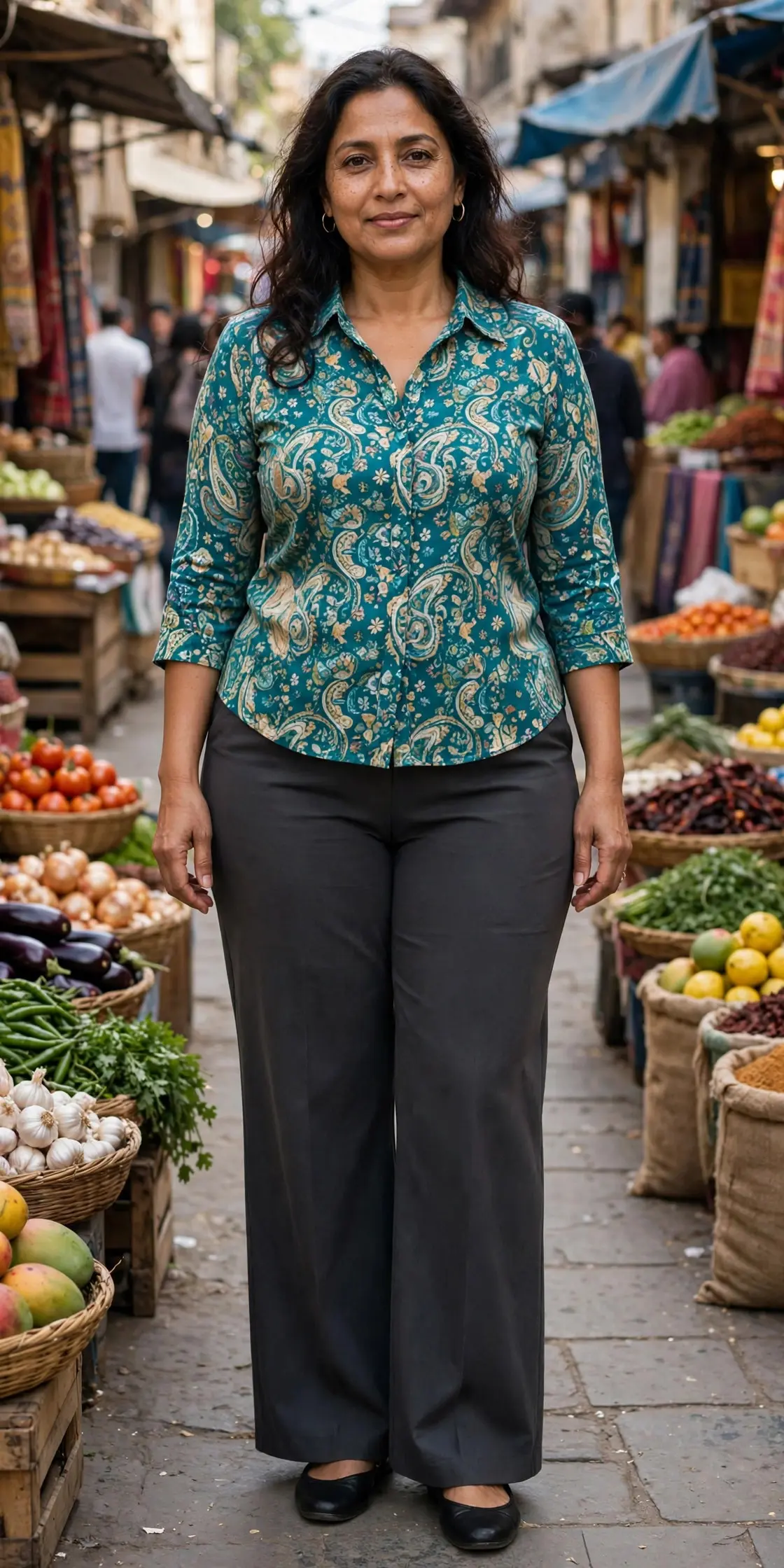
Big polka dots, loud stripes, cargo pockets, and contrast stitching all shout from exactly the area you are trying to keep calm. Busy bottoms pull every glance downward and undo the balance your top is working to create.
Move the party upstairs instead: a patterned or brightly colored top over plain, dark, solid bottoms — like the teal paisley blouse with charcoal trousers shown here — keeps the outfit interesting and the proportions serene. The bottoms stay appealing through cut and fabric, never through noise.
Tip: Details are not banned from the lower half entirely; they just need to whisper. Flat-front pockets, tonal stitching, and subtle texture add polish without adding visual weight.
Shop this look: Floral Blouse · Black Trousers
10. Very Short Crop Tops

A top that ends halfway up the torso chops the body at an awkward point and throws a spotlight on everything below the break. The shorter the top, the wider the hips tend to read by comparison.
The flattering alternative keeps the modern feel without the harsh break: a top that ends right at your natural waist or high hip, meeting a high-waisted bottom with no gap. The proportion stays fresh, but the line runs smoothly from shoulder to hip.
Fit note: Do the reach test before you buy — raise both arms overhead. If the hem climbs and the outfit falls apart, that top belongs to a different styling job.
Shop this look: Scoop Neck Top · High Waisted Jeans
11. Extremely Baggy Pants

It is tempting to hide fuller hips under maximum fabric, but volume everywhere backfires: the waist disappears, the silhouette turns column-like, and the lower half ends up looking bigger, not smaller.
Wide legs themselves are wonderful on a pear shape — they just need tailoring. Trousers that fit cleanly at the waist and hip, then fall in a fluid, pressed line give you the ease of a wide leg with none of the bulk.
Tip: Try the pinch test at the hip: if you can gather more than a couple of inches of spare fabric, the pants are wearing you. A tailor can usually fix it in one visit.
Shop this look: Black Wide Leg Trousers · Linen Wide Leg Trousers
12. Low-Rise Jeans

A low-rise waistband parks itself on the widest point of a bottom-heavy figure, where it digs, bunches, and creates spillover that no top can quite smooth away. It also shortens the leg line it sits on. It is a small band of denim making a surprisingly big visual mistake, every single time.
Mid-rise and high-rise jeans solve all of it at once: the waistband settles at your natural waist — your narrowest point — so it smooths, supports, and quietly lengthens your legs in the process.
Fit note: Always do the fitting-room sit test. The right rise stays put when you sit and bend, with no digging at the front and no gaping at the back.
Shop this look: High Waisted Jeans · Dark Wash Jeans
13. Mini Skirts

A very short hem lands at the fullest part of the thigh and cuts the leg off early, which exaggerates hip width and leaves the outfit feeling top-heavy in reverse — all leg below, all width at the hemline.
The more flattering length gives your curves a longer runway: a knee-length A-line skirt that releases gently from the waist and skims the hips. It keeps the playful spirit of a skirt while reading elegant and balanced.
Tip: Aim hems at the slimmest points of the leg — just above or just below the knee — rather than across the widest part of the thigh. It is a small shift with an outsized effect.
Shop this look: A-Line Midi Skirt · Black A-Line Midi Skirt
14. Very Stiff Fabrics

Board-stiff fabric cannot follow a curve, so it stands away from the body in boxy angles — and those angles add phantom width right where a bottom-heavy figure least needs it. Stiff skirts and trousers can look bulky even in the perfect size.
Fluid fabrics with real drape do the opposite: crepe, soft jersey, viscose, and silk-like blends pour over the hips and fall in clean, moving lines. A wrap dress in a fluid knit shows how gracefully fabric can follow a shape instead of fighting it.
Fit note: Use the scrunch test in store: squeeze the fabric in your fist for five seconds. If it stays harshly creased and crackly, it will likely fight your curves all day.
Shop this look: Wrap Dress · Crepe Blouse
15. Straight-Cut Dresses

A straight-cut dress hangs from the bust and lands wherever it lands — usually clinging or pooling at the hips while hiding your waist, which happens to be a bottom-heavy figure’s best feature. The result reads shapeless rather than sleek.
Fit-and-flare and wrap silhouettes were practically designed for this shape: they define the waist, then release generously over the hips and thighs. The eye registers an hourglass balance even though the dress did all the work.
Tip: Already own straight dresses you love? Add a slim belt at your natural waist and layer a soft open cardigan over the top — you will recover the waist definition in seconds.
Shop this look: Fit And Flare Dress · Empire Waist Maxi Dress
16. Horizontal Stripes
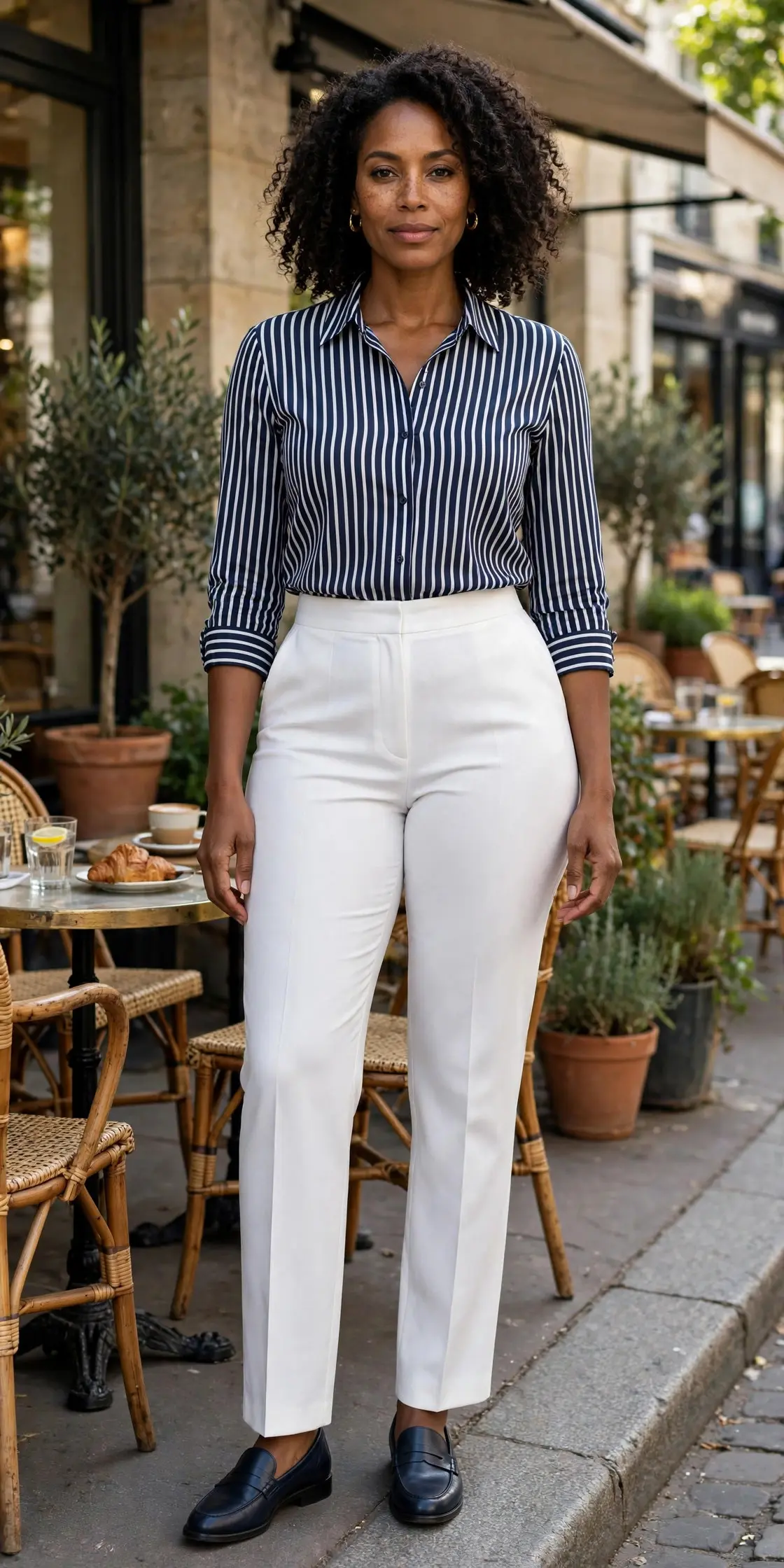
Horizontal lines widen whatever they cross — that is simply how the eye reads them. Stripes circling the hips and thighs at their fullest point make that width the headline of the whole outfit.
Vertical stripes run the other way, literally: they draw the eye up and down, lengthening the torso and the leg. A fine pinstripe blouse or a vertically seamed dress gives you pattern with a built-in elongating effect. Seams, pressed creases, and a long pendant necklace borrow exactly the same up-and-down trick without any print at all.
Tip: If you adore a classic Breton stripe, wear it on top, where a little extra width actually helps balance your hips — and pair it with plain dark bottoms to keep the equation working.
Shop this look: Pinstripe Blouse · Long Pendant Necklace
17. Oversized Statement Belts

A very wide, high-contrast belt plants a billboard across your midsection. Instead of defining the waist, it chops the torso, draws a hard horizontal line, and can make the hips below it look wider by comparison.
The fix keeps all the benefit with none of the noise: a slim, proportionate belt — around an inch to an inch and a half wide — sitting exactly at your natural waist. In a tonal shade, it marks the waist quietly and lets the outfit’s lines stay long.
Tip: If a dress already has a shaped waist seam doing the work, skip the belt entirely. One waist-defining detail per outfit is the sweet spot.
Shop this look: Skinny Belt · A-Line Skirt
Styling Tips
Once the big silhouettes are right, these small habits keep every outfit balanced:
- Check the hem landing zone. In the mirror, note where tops and hems end. Above or below the widest point of your hip works; directly across it rarely does.
- Use value contrast on purpose. Lighter or brighter above the waist, deeper and quieter below it — the simplest balance formula there is.
- Take the photo test. A quick phone photo shows proportion more honestly than a mirror. Shoot new outfits before you wear them out.
- Anchor the waist in every outfit. A tuck, a slim belt, or a shaped seam — pick at least one, every single time.
- Keep one vertical line going. An open jacket’s edges, a long pendant, or a pressed trouser crease all pull the eye up and down instead of side to side.
- Buy for the hip, tailor the waist. Fit the fullest point first, then have the waist nipped in. It is the pear-shape shopping rule that never fails.
Common Mistakes to Avoid
Beyond the ten traps above, watch for these everyday habits that quietly unbalance an outfit:
- Letting tops end at the widest hip point. That horizontal hemline underlines your width. Tuck, crop to the waist, or go longer and leaner.
- Hiding the waist entirely. Boxy layers meant to camouflage usually add bulk and erase your best proportion asset.
- Shiny or very pale fabrics on the bottom half. Satin and light-wash denim reflect light at the hip and thigh, visually enlarging them.
- Carrying a tiny shoulder bag. A very small bag looks out of scale against fuller hips; a medium structured bag restores the balance.
- Dressing to hide instead of to balance. The goal was never to make your curves disappear — it is to give the whole outfit equal visual weight, top and bottom.
Wrapping Up: What to Wear With a Bottom-Heavy Body
Dressing a bottom-heavy body really comes down to three moves: put the interest up top, keep the waist visible, and let your bottoms skim in darker, calmer fabrics. Everything in this guide — the bootcut swap, the slim belt, the vertical stripe — is just one of those three moves in disguise. Master those three, and getting dressed stops being a daily negotiation and starts being a routine you genuinely enjoy.
When you want a no-thinking-required outfit, reach for these combinations:
- A bright or detailed top with a dark A-line skirt
- A tucked-in blouse with high-waisted wide-leg trousers
- A fit-and-flare dress with a slim belt at the waist
- A patterned top with plain dark bootcut jeans
- A statement necklace over a simple dark dress
Frequently Asked Questions
What is a bottom-heavy (pear) body shape?
It is a shape where the hips and thighs measure fuller than the bust and shoulders, usually with a defined, narrower waist. Your weight and curves sit mainly below the waist — and with balanced styling, that contrast becomes your most elegant feature.
Can I wear skinny jeans if I am bottom-heavy?
Yes — with a few adjustments. Choose a dark rinse with a mid or high rise, avoid ultra-tight spray-on fits, and balance the slim leg with a longer or more detailed top and a boot or shoe with a little heel. The proportions matter more than the jean itself.
What rise of jeans is best for a bottom-heavy body?
A mid-rise or high-rise that sits at your natural waist. It smooths the midsection, avoids bunching at the hip, supports your curves, and lengthens the leg line — everything a low rise works against.
How do I balance wider hips without hiding them?
Add interest above the waist with color, print, neckline detail, or accessories; keep the waist defined; and choose bottoms that skim in darker solids. You are not disguising your hips — you are giving the top half equal visual presence so the whole outfit reads in harmony.
Your curves were never the problem to solve — they are the shape every one of these tips is designed to celebrate. Start with one change this week, whether it is the rise of your jeans or a brighter top, and notice how quickly the mirror responds. And when you are ready to zoom out, our guide to how to dress for your body type shows how these same balance principles adapt to every shape. Now tell me: learning how to dress for a bottom-heavy body, which of these 17 tips are you trying first?
Recommended Products
| Product | Amazon link |
|---|---|
| V-Neck Blouse | V-Neck Blouse |
| Floral Blouse | Floral Blouse |
| A-Line Skirt | A-Line Skirt |
| High Waisted Jeans | High Waisted Jeans |
| Teal Silk Blouse | Teal Silk Blouse |
| Black Trousers | Black Trousers |
| Ponte Trousers | Ponte Trousers |
| Shirt Dress | Shirt Dress |
| Statement Necklace | Statement Necklace |
| Silk Scarf | Silk Scarf |
| Pointed Toe Pumps | Pointed Toe Pumps |
| Pointed Toe Heels | Pointed Toe Heels |