15 Style Secrets for Petite Women With Big Busts to Create a Flattering Silhouette
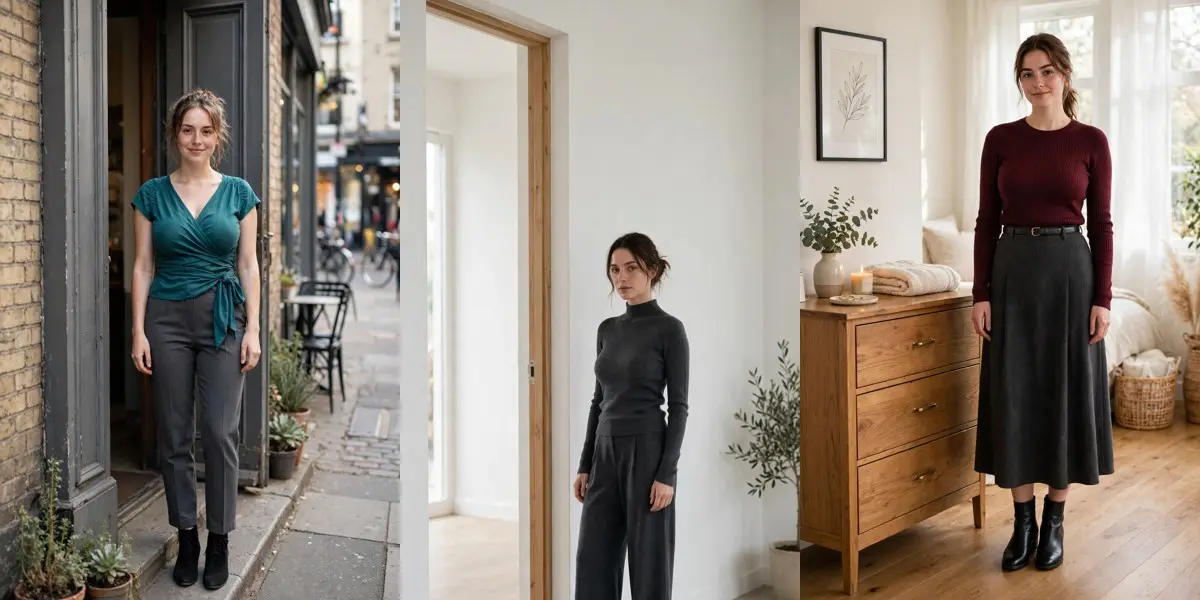
If you are petite with a full bust, you know the drill: tops that fit your chest hang like a tent everywhere else, and petite sizing rarely accounts for your cup size. These style secrets for petite women with big busts fix the real problems — necklines, waist placement, fabrics and foundations.
Inside are 15 practical secrets, each shown on a real outfit: the bra that lifts your whole silhouette, the necklines that lengthen a short torso, the tailoring trick that makes off-the-rack pieces look made for you, and the small details — long necklaces, pointed toes — that pull it all together.
None of this is about hiding your bust. It is about proportion: giving your waist back, keeping lines vertical, and choosing pieces cut for a shorter frame. Start with the foundation secret, and the rest of your closet will suddenly make sense. If a fuller bust is your main concern at any height, our big bust outfit ideas are the perfect companion read.
As an Amazon Associate, I earn from qualifying purchases.
In This Guide
- 1. Get Fitted for a Bra in Your True Band Size
- 2. Choose V and Sweetheart Necklines Over High Crews
- 3. Use Ruching and Wrap Tops to Skim, Not Squeeze
- 4. Swap Stiff Poplin for Fluid Fabrics
- 5. Tuck Everything (or Half-Tuck) to Reclaim Your Waist
- 6. Raise Your Waistline With High-Rise Bottoms
- 7. Buy the Bust Size, Then Tailor the Waist
- 8. Keep Jackets and Blazers Fitted at the Shoulder
- 9. Build Outfits in One Column of Color
- 10. Use Vertical Details: Buttons, Piping, Open Cardigans
- 11. Size Up in Knitwear and Belt the Waist
- 12. Pick the Right Swimwear: Underwire and High-Waist
- 13. Skip the Statement Statement Necklace — Go Long Instead
- 14. Choose Slim Straps and Racerbacks for Support
- 15. Master the Half-Size Shoe and Pointed Toe
- Styling Tips
- Common Mistakes to Avoid
- Building Your Petite Busty Capsule
- Frequently Asked Questions
1. Get Fitted for a Bra in Your True Band Size
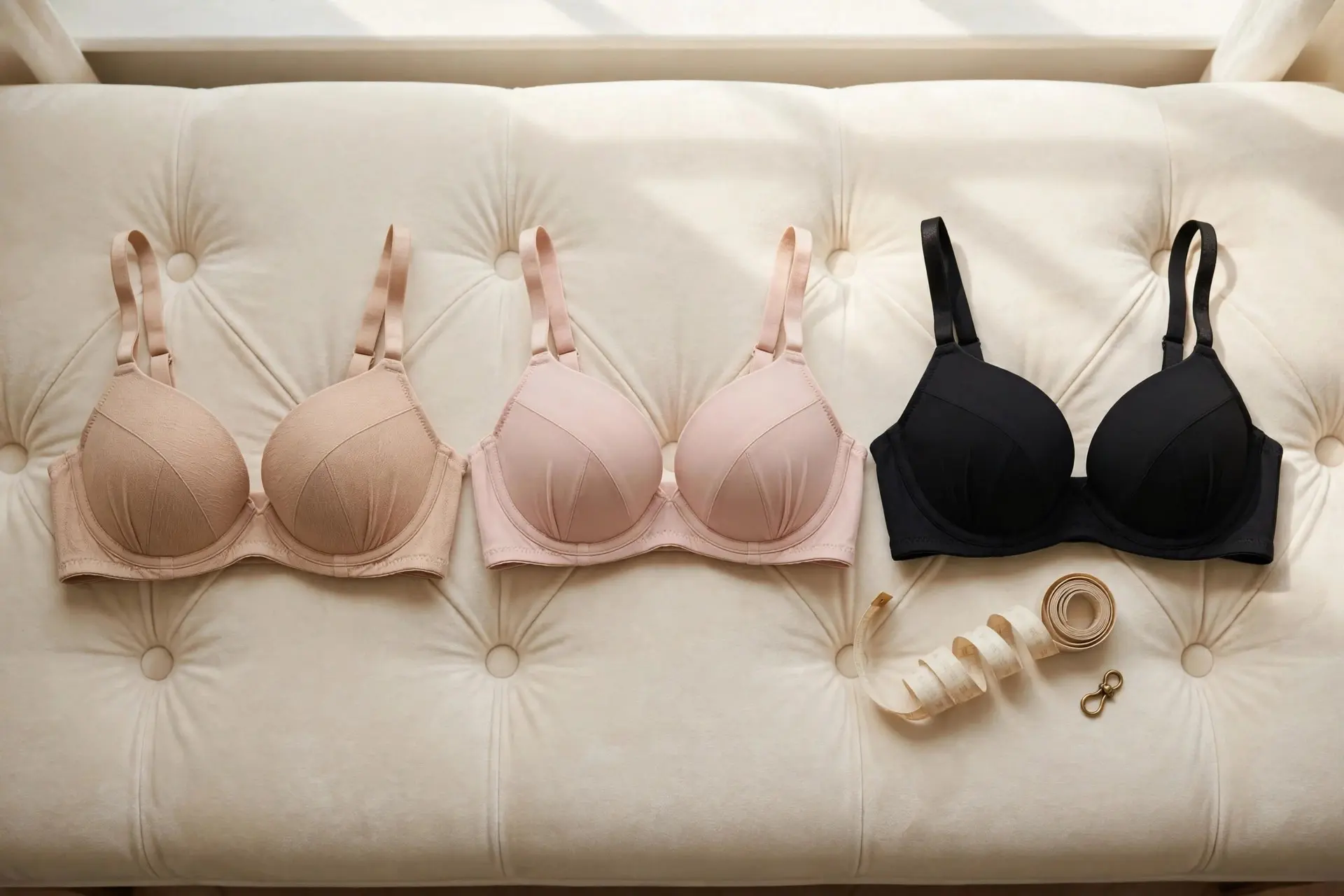
Here is the secret underneath all the others: most petite, full-busted women are wearing a band size that is too big. A 30F and a 34D hold roughly the same volume, but the loose 34 band lets the bust sit low, eating up the little torso length you have. A snug band lifts everything upward and hands you back visible inches of waist.
Get properly measured, or run your measurements through a good online calculator — it takes five minutes. Look for seamed cups with side-support panels and a low center gore: seams shape and project forward, while molded cups mostly add rounded bulk. Choose a shade close to your skin or your most-worn tops so the bra disappears underneath.
Fit note: Order two or three sizes around your measured result from a retailer with free returns. The right band sits level, stays put when you raise your arms, and lets the center gore rest flat against your sternum.
Shop this look: Full Coverage Bra and Minimizer Bra.
2. Choose V and Sweetheart Necklines Over High Crews

A high crew neck draws one horizontal line straight across the fullest part of your chest — on a short frame, it can make your bust look like it starts at your chin. A V-neck does the opposite: it carves a vertical channel down the center of your body, lengthening your neck and dividing the visual width of your bust into two narrower halves.
Aim for a V that ends about three to four inches below your collarbone. That is the sweet spot — deep enough to create the line, modest enough to stay secure all day. A sweetheart neckline delivers the same lengthening with a softer curve, and it flatters both round and shallow bust shapes beautifully.
Tip: Love a crew-neck sweater anyway? Recreate the vertical with a long pendant that drops into that same three-to-four-inch zone. It takes two seconds and changes the whole read of the outfit.
Shop this look: Sweetheart Neckline Top and V Neck Sweater.
3. Use Ruching and Wrap Tops to Skim, Not Squeeze
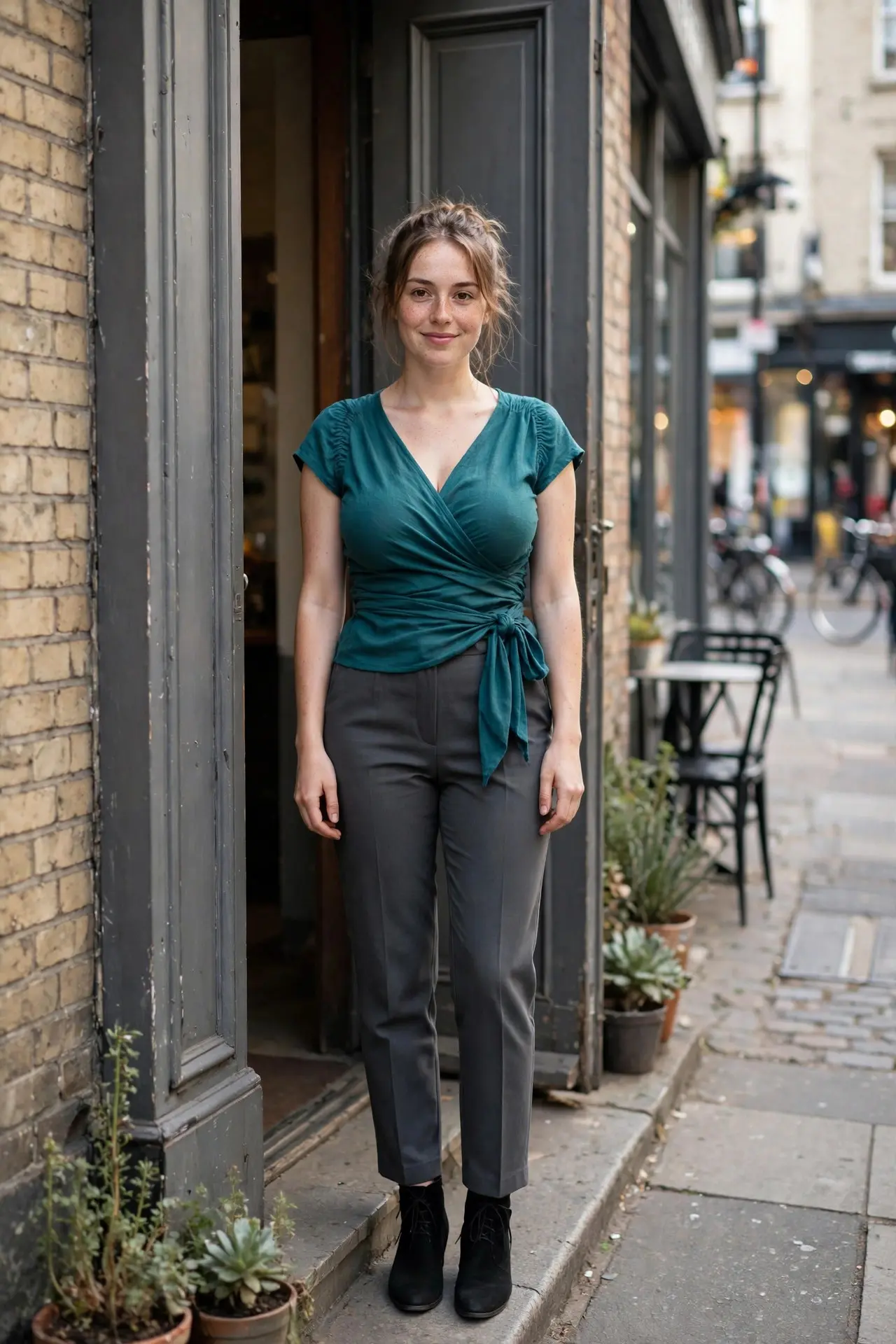
The enemy on a small frame is not volume — it is tension. Fabric stretched tight across a full bust gapes, pulls and wrinkles horizontally, and the whole garment looks strained. Wrap tops and side-ruched styles solve it structurally: the fabric is gathered and angled rather than pulled flat, so it accommodates your shape without gripping it.
Look for wraps with a snap or hidden hook at the bust so the neckline stays where you put it. If you are between sizes, choose a true wrap you tie yourself over a fixed faux-wrap — you can cinch the waist exactly and adjust the overlap so the bust sits smoothly. Side ruching on a tee or dress pulls the fabric diagonally, which also disguises cling.
Tip: In the fitting room, raise both arms overhead. If the neckline gapes or the waist migrates, size up and tighten the tie instead — the wrap should move with you, not against you.
Shop this look: Black Wrap Top and Ruched Side Top.
4. Swap Stiff Poplin for Fluid Fabrics
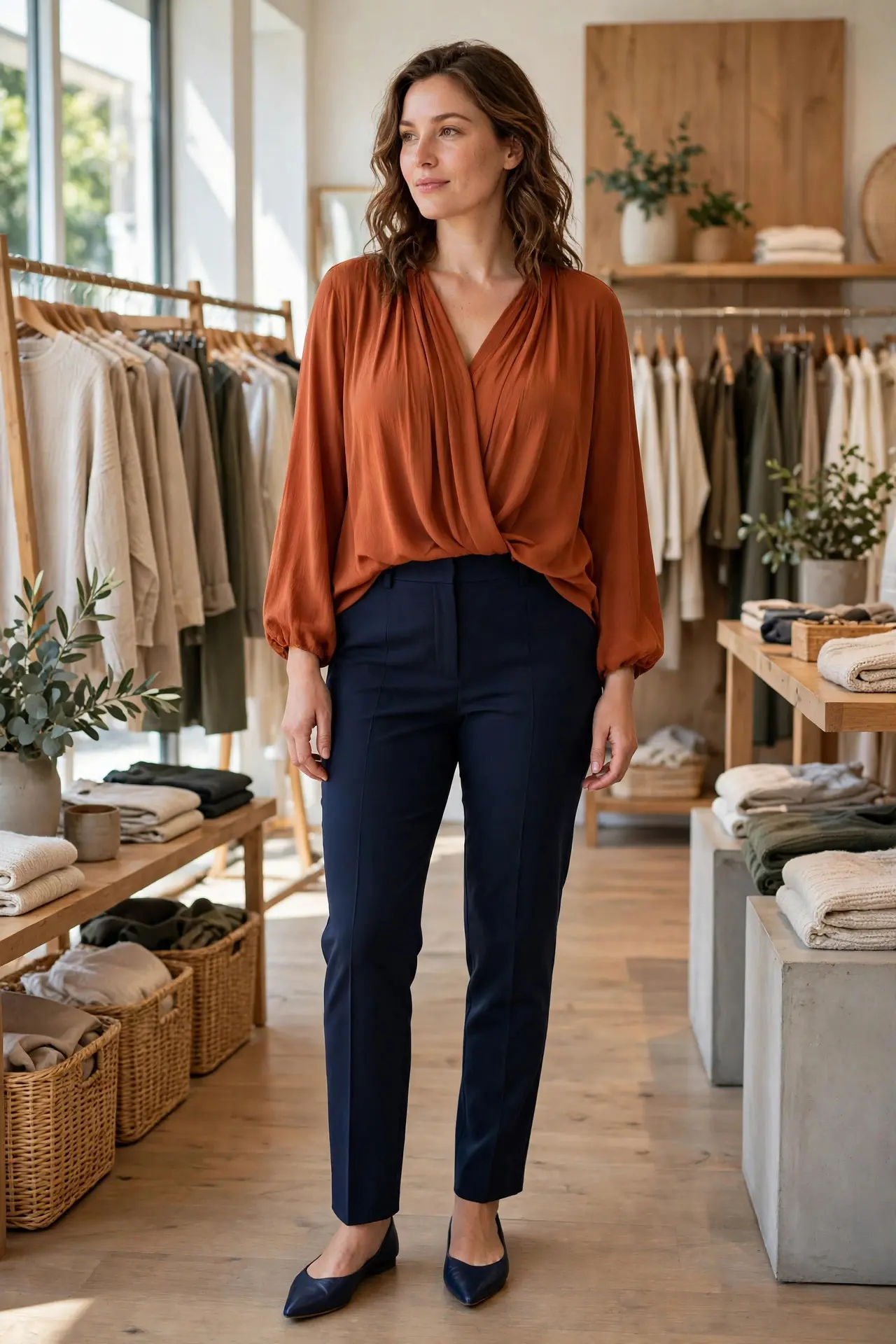
Crisp poplin and stiff linen have a bad habit: they stand away from the body in a rigid shape, hovering over your curves instead of following them. Over a full bust, that tent effect adds width exactly where you are already widest. Fluid fabrics drape downward along your shape, keeping your silhouette close, smooth and vertical.
Reach for jersey, crepe, silk blends, fine merino, Tencel and modal. They carry enough weight to skim rather than cling, and they move with you so no single point looks strained. Crepe is the workwear hero — it keeps a pressed, professional finish without poplin’s board-like structure — and fine-gauge merino gives winter warmth without a bulky layer over your chest.
Tip: Use the squeeze test in store: grab a handful of fabric and squeeze. If it springs back stiff and papery, it will behave that way on your body. If it collapses softly and falls, it will drape beautifully.
Shop this look: Silk Blouse and Satin Slip Skirt.
5. Tuck Everything (or Half-Tuck) to Reclaim Your Waist
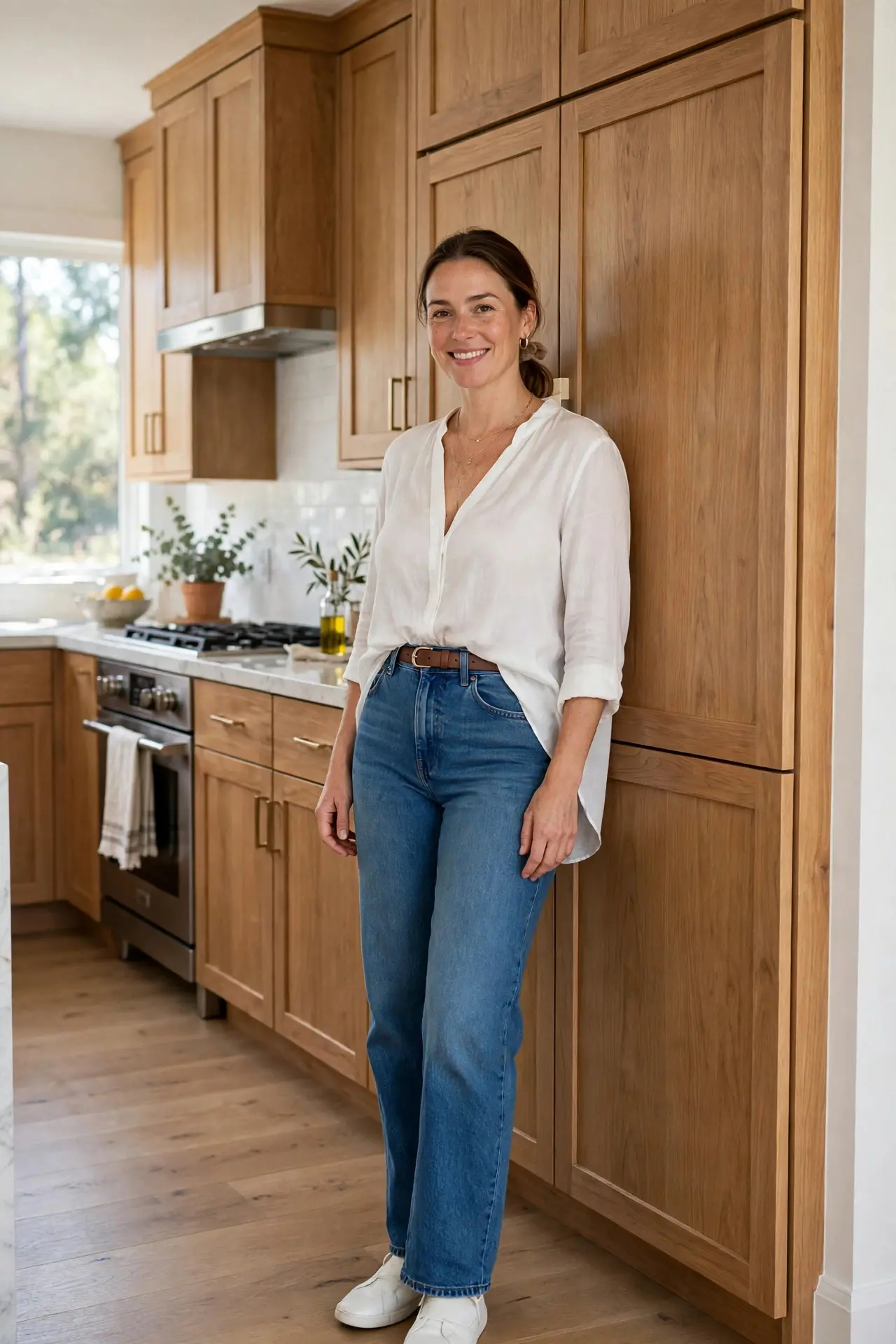
An untucked top falling past your hips over a full bust creates one long, unbroken column — and on a petite frame that column reads boxy and steals visible inches from your legs. Your waist vanishes, because the eye finds no marker between bust and hem. Tucking is the fastest fix there is, and it costs nothing.
Go for a full front tuck into high-waisted bottoms, leaving the back loose if you prefer the coverage. Or try the French tuck: just the center-front of the top pulled into the waistband, sides left to fall. It is forgiving over the stomach while still marking your waist. A slim belt at your natural waist — usually just below the ribcage — finishes the proportion rebuild.
Tip: If a top feels too short to tuck, it usually is not — mid-hip blousy tops are the ones that swamp you. A top that ends near the waistband is exactly the right length for a petite frame.
Shop this look: Leather Belt and High Rise Skinny Jeans.
6. Raise Your Waistline With High-Rise Bottoms
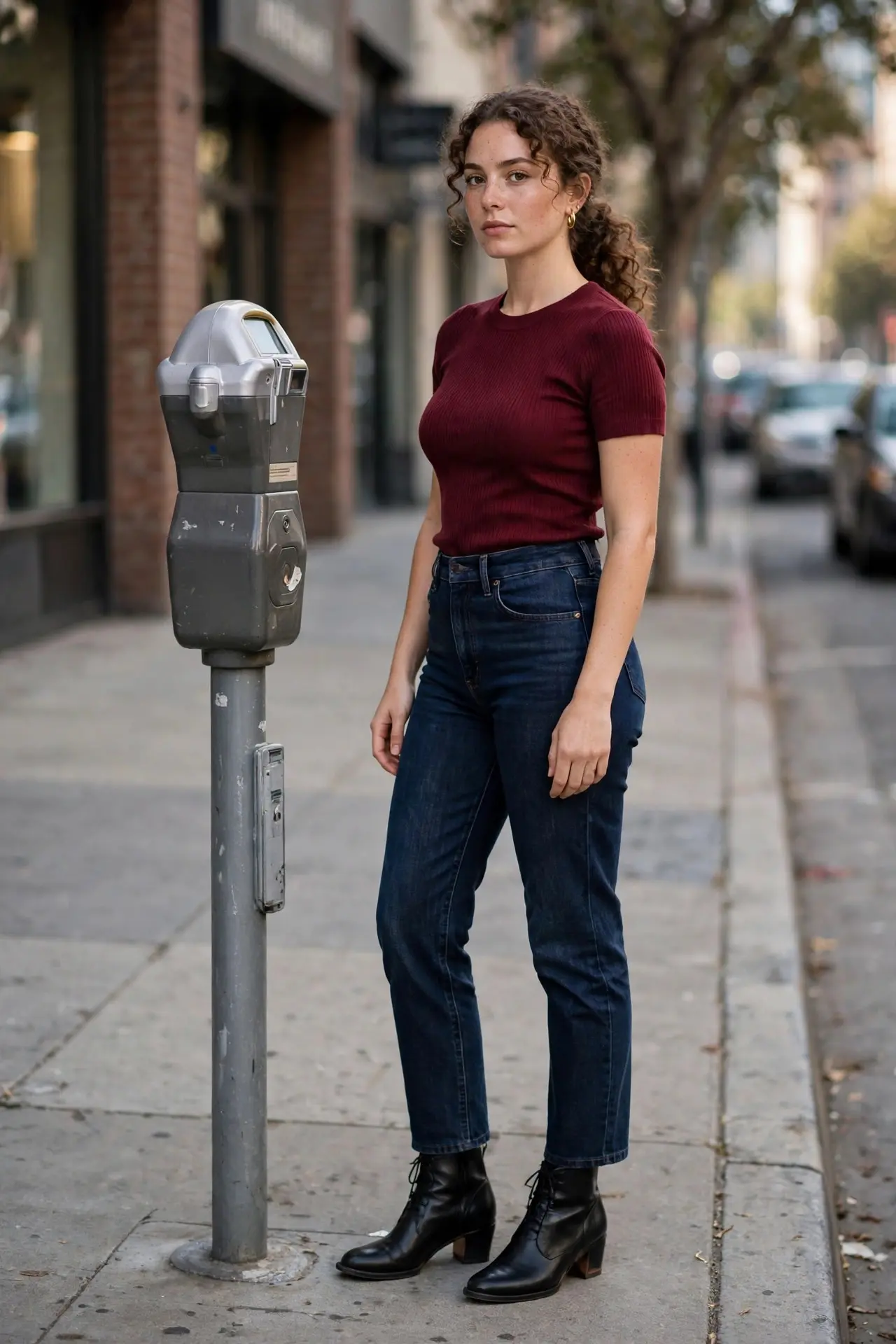
Where your top meets your bottom is the most powerful proportion decision you make each morning. Low and mid rises place that meeting line across your hips or below your stomach, visually cutting your leg length — the last thing a petite woman needs. High-rise bottoms meet your top at your narrowest point and let your legs read as long as they truly are.
Look for a genuine ten-to-twelve-inch rise, and pair it with a tucked or cropped top that ends at or just above the waistband — never mid-torso, which chops a short frame into awkward blocks. High-rise straight-leg jeans, tailored trousers and A-line midi skirts all work. If you are short-waisted as well as petite, high-rise is non-negotiable.
Fit note: Check the rise measurement, not the label. Anything under ten inches will not reach a petite natural waist, no matter what the tag calls it.
Shop this look: White High Rise Jeans and Leather Belt.
7. Buy the Bust Size, Then Tailor the Waist
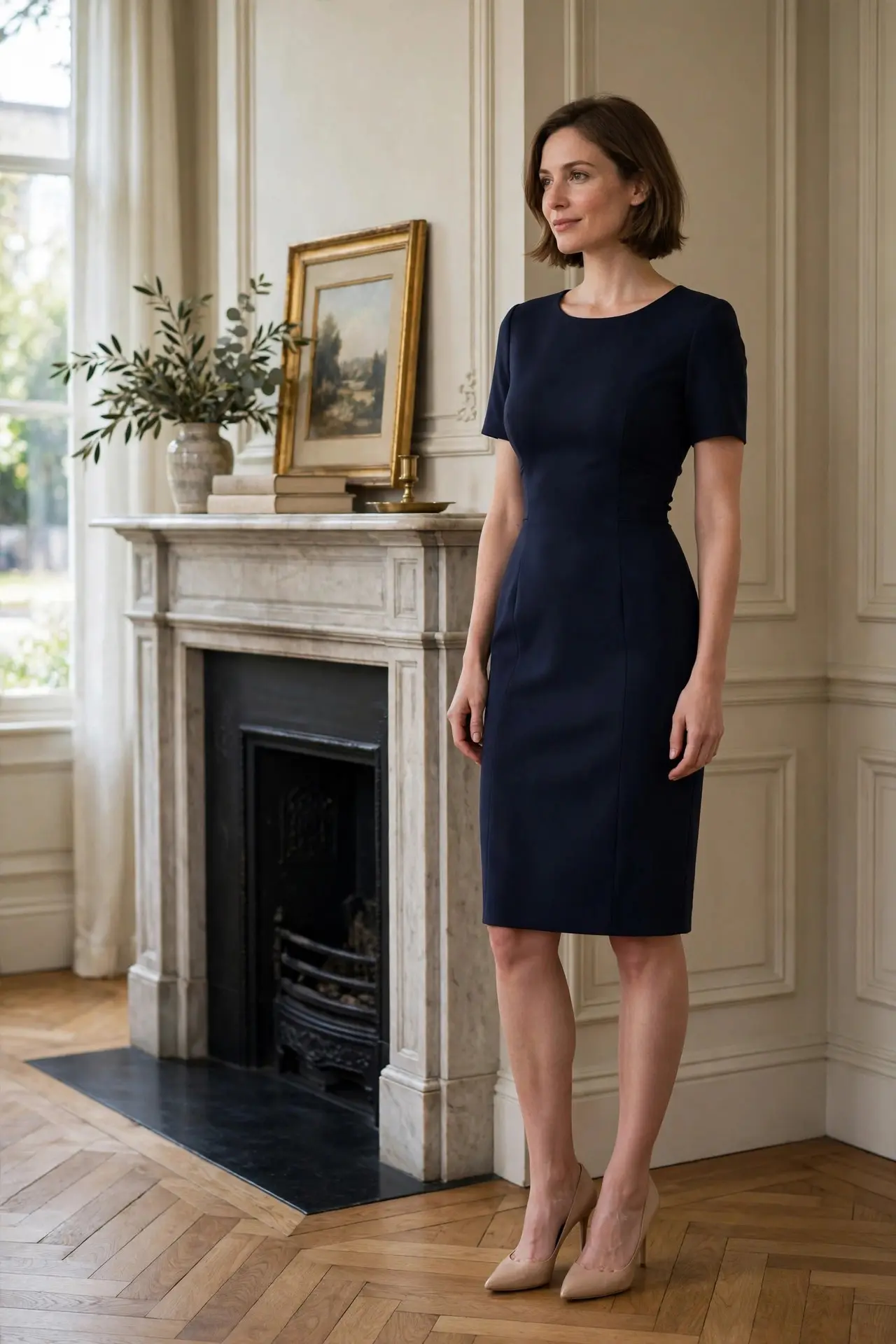
Here is the reframe that changes shopping forever: a garment does not have to fit perfectly off the rack to be the right purchase. If a dress fits your bust and hangs loose at the waist, that is not a failure — you have found the hard part. Manufacturers grade for one standard proportion; a small frame with a full bust simply is not it.
A tailor fixes the rest for roughly $20–$40. Ask for waist suppression: the side seams taken in and back darts added or deepened, so the fabric follows your shape instead of tenting. Sleeves bought long for the bust size can be shortened at the same visit. This one habit resolves most fit problems, because it lets you shop for your chest and your waist as two separate, solvable measurements.
Tip: Pin the side seams yourself at home first to see how much needs to come in, then bring the garment to the tailor with the pins in place — it saves a fitting round and gets a better result.
Shop this look: Wrap Dress and Leather Belt.
8. Keep Jackets and Blazers Fitted at the Shoulder
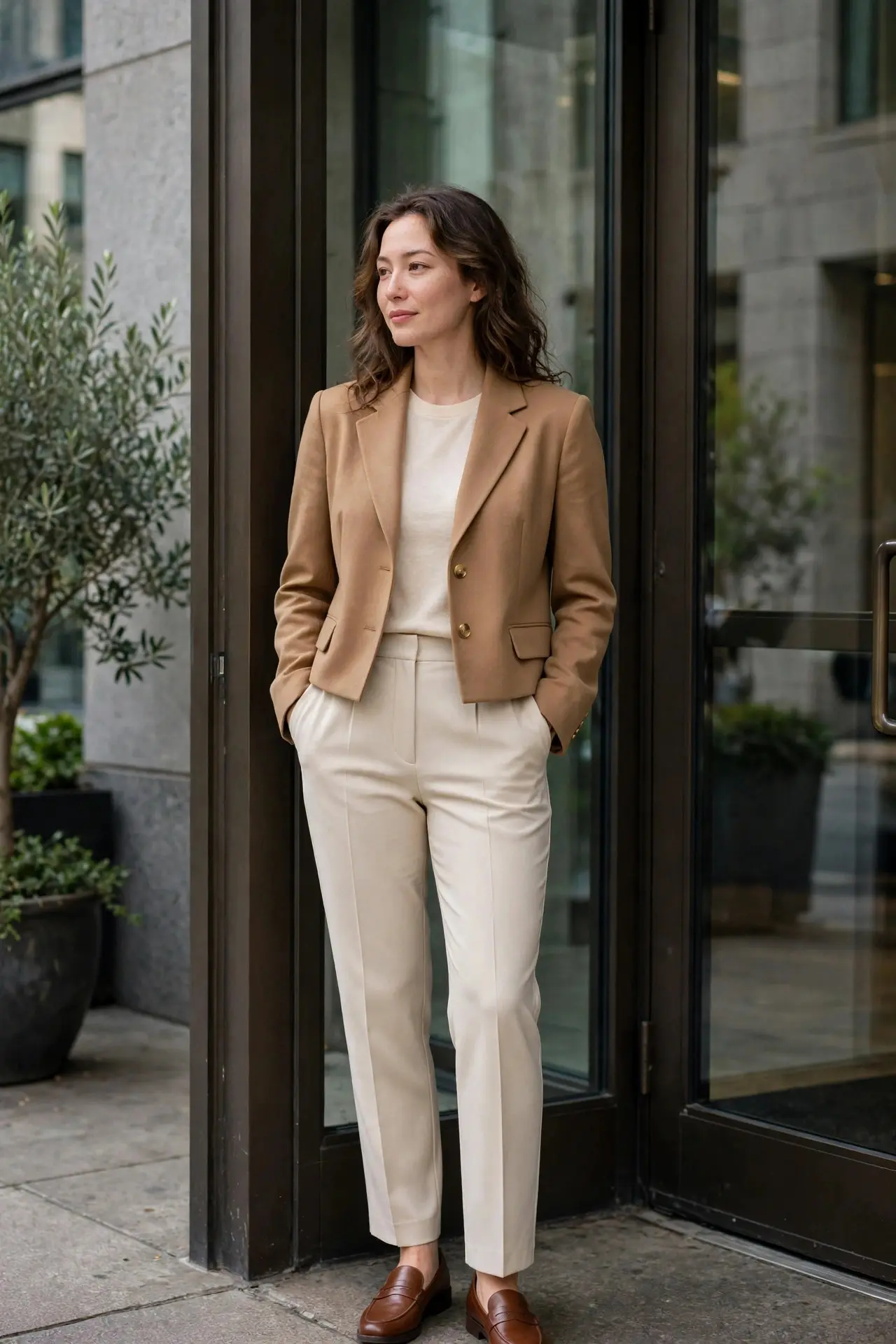
Shoulder fit is the one measurement to check before anything else. The seam should sit exactly on your shoulder bone, where your arm begins. Let it droop past that point and the whole jacket reads as borrowed, shrinking your frame. Sleeves and waists can be altered; shoulders essentially cannot, short of rebuilding the garment.
Look for single-breasted, nipped-waist blazers with a gently curved front hem — the curve skims over the bust instead of cutting across it. Skip double-breasted styles: the overlapping front and double button rows add bulk right across the chest. A cropped blazer ending at the high hip is a petite’s best friend, because it preserves leg length instead of ending at the widest part of the thigh.
Fit note: Between sizes? Buy the one that closes over your bust and have the waist taken in. On a three-button style, fasten only the middle button to keep a vertical line open.
Shop this look: Black Blazer and White Button Down Shirt.
9. Build Outfits in One Column of Color
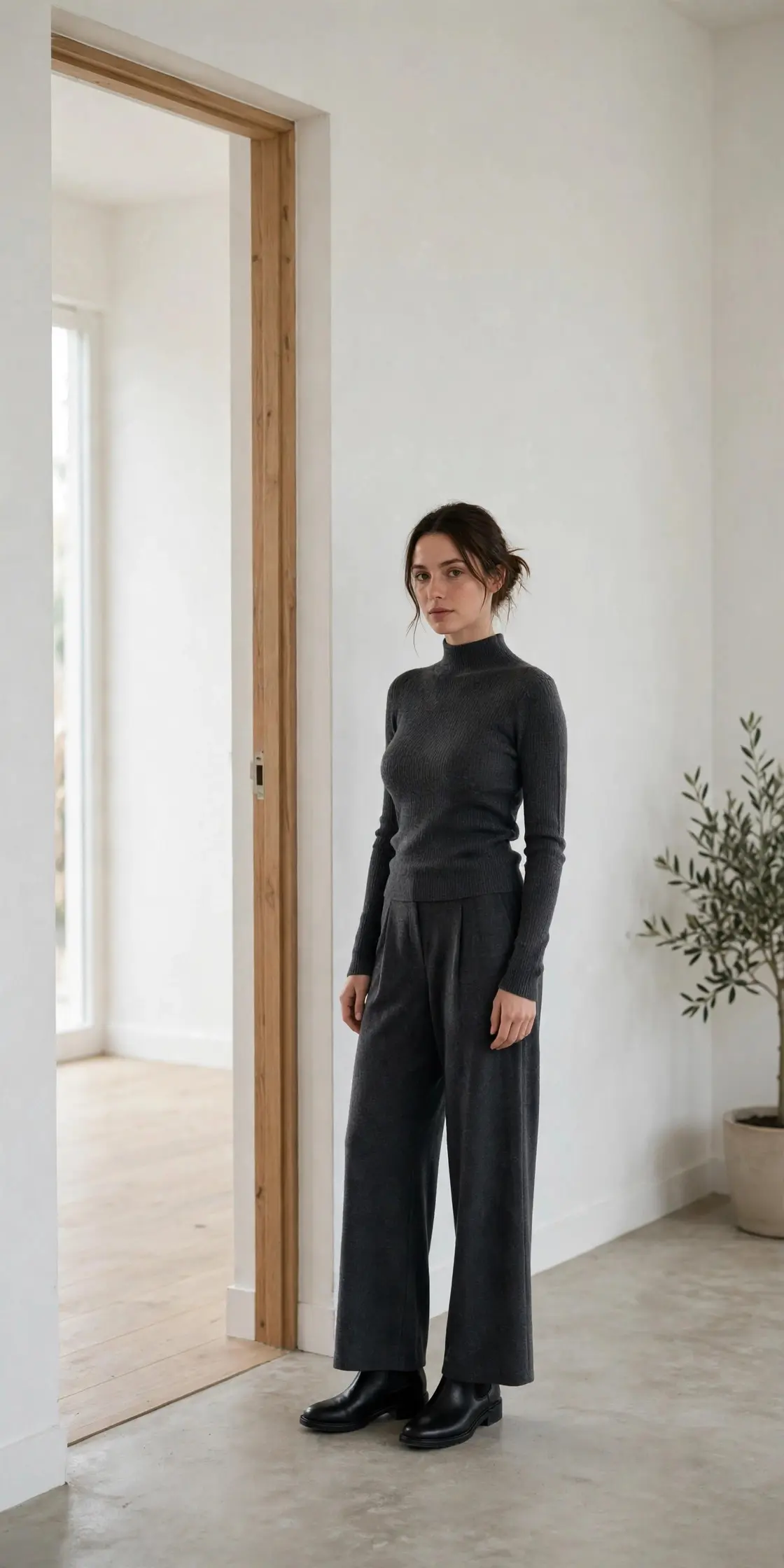
Head-to-toe tonal dressing creates one unbroken vertical line from shoulders to shoes. You look taller, and the eye glides past your chest instead of stopping there. Think charcoal knit, charcoal wide-leg trousers, black boots — or a navy top and trousers finished with a nude shoe. You are read as a single column, not a stack of horizontal breaks.
Within the column, keep deeper shades on top. Dark colors recede visually, while white and pastels advance and magnify — the opposite of what you want across a full bust. If you love a light color, wear it on the bottom half and keep the top deep. The pieces do not need to match exactly; close values and tones read as one.
Tip: Lay the outfit flat on the bed before you wear it. If you see three distinct horizontal bands of color, swap one piece so the top and bottom blend into a single line.
Shop this look: Black Jumpsuit and Black Ankle Boots.
10. Use Vertical Details: Buttons, Piping, Open Cardigans
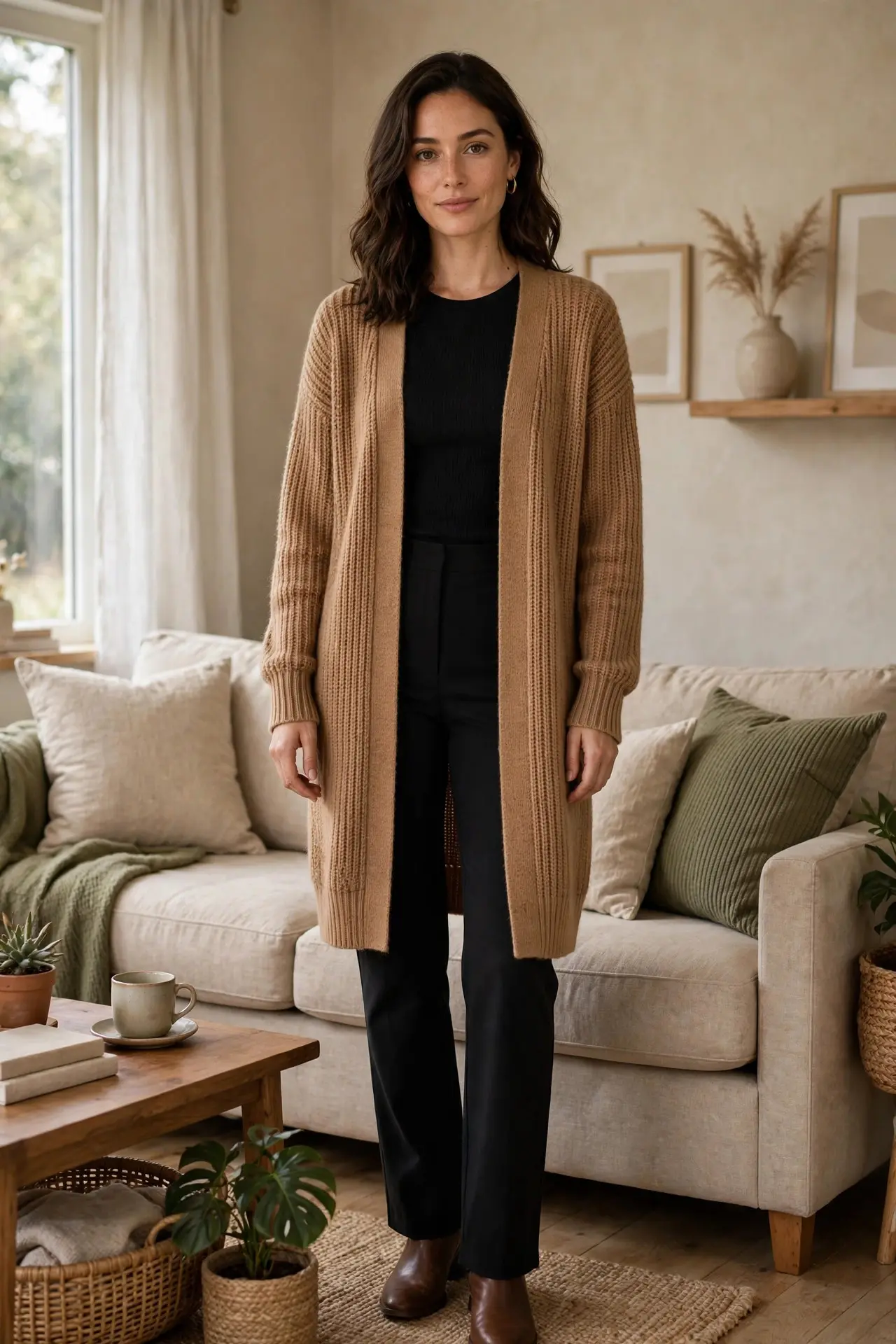
Vertical lines steer the eye up and down instead of side to side, and balancing a full bust is mostly a matter of controlling where the eye travels. A single column of buttons down a shirt front, a center seam on a dress, fine piping, a vertical-print blouse — each one lengthens you instantly, with no shapewear and no effort.
The open cardigan is the workhorse of this secret. Worn unbuttoned over a fitted top, it draws two clean vertical edges down your torso and breaks up the width of your chest. On a petite frame, choose one that reaches mid-thigh to knee — a cropped cardigan stops the line short and turns boxy. Fine knits with a little drape fall straightest.
Tip: On prints, choose stripes, fine geometrics or small-scale vertical florals. Save large horizontal patterns and oversized blooms across the chest for a different outfit.
Shop this look: Striped Long Sleeve Shirt and Black Cardigan.
11. Size Up in Knitwear and Belt the Waist
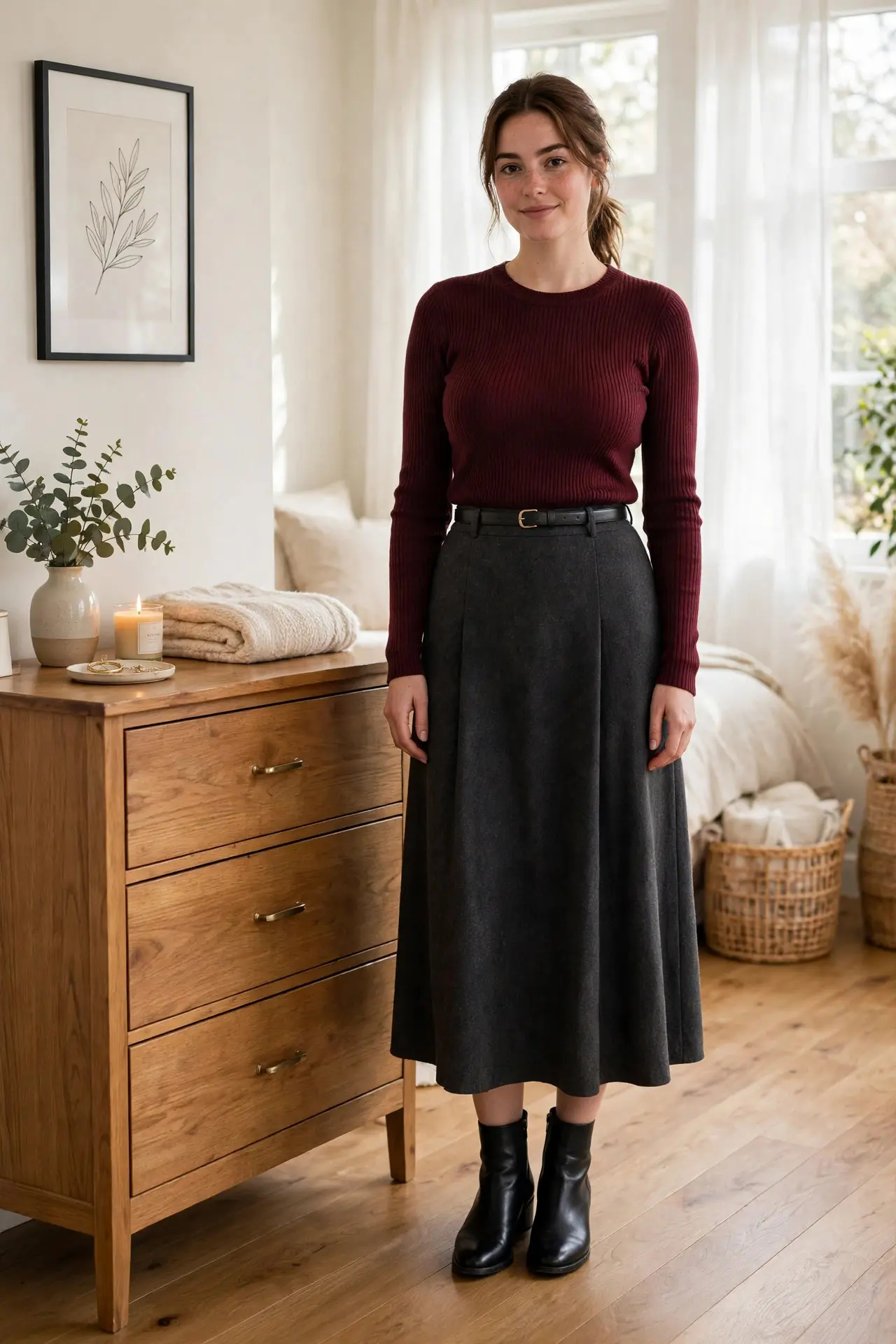
Fine-gauge knits are honest — they show every curve of a full bust, which is not always the read you want for work or family photos. The fix is not a bigger, shapeless sweater. It is sizing up one for a smooth, unstrained line across the chest, then bringing your waist back with a slim belt worn over the knit or a knit midi dress.
Texture matters as much as size. Choose ribbed or pointelle knits over chunky cable: heavy, textured yarn stacks visual weight exactly where you are fullest, while fine ribs skim. And note the exception — a thin cashmere or merino crew in your true size, worn tucked, often beats a bulky oversized sweater, because the tuck rebuilds your waist and the fine gauge keeps the line close without clinging.
Fit note: Keep the belt slim — one to one-and-a-half inches — and close in color to your knit, so it defines your waist without slicing you in half.
Shop this look: Chunky Knit Sweater and Leather Belt.
12. Pick the Right Swimwear: Underwire and High-Waist
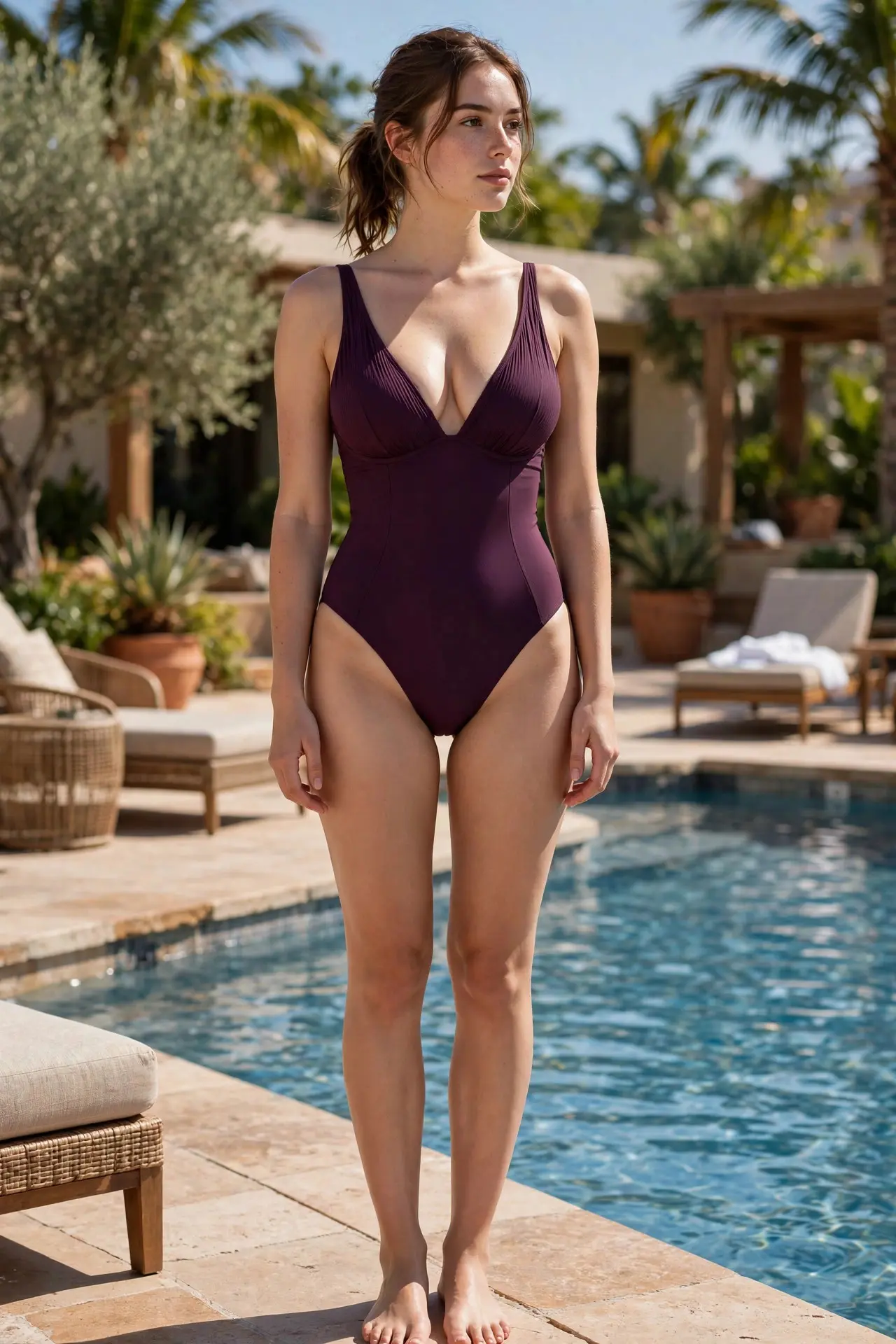
Swimwear is where busty petites give up too early — usually because they have only tried stretchy triangles that flatten, slide and support nothing. The fix comes in two parts: a cup-sized swim top with real underwire, and high-waisted bottoms. DD+ swim brands build tops in actual bra sizes, so a 32F gets structure engineered for a 32F.
For the neckline, choose a plunging V or a halter with a wide, supportive tie — both keep the line vertical and lift rather than compress. Avoid bandeau styles: they squash a full bust and have nothing holding them up, so you will spend the day tugging. High-waisted bottoms raise the visual waist and extend the leg line, exactly the balance a petite frame needs under a fuller chest.
Fit note: The band should sit firm and level all the way around, never riding up at the back. If you can easily slide two fingers underneath, go down a band size.
Shop this look: Underwire Swimsuit and High Waisted Bikini.
13. Skip the Statement Statement Necklace — Go Long Instead
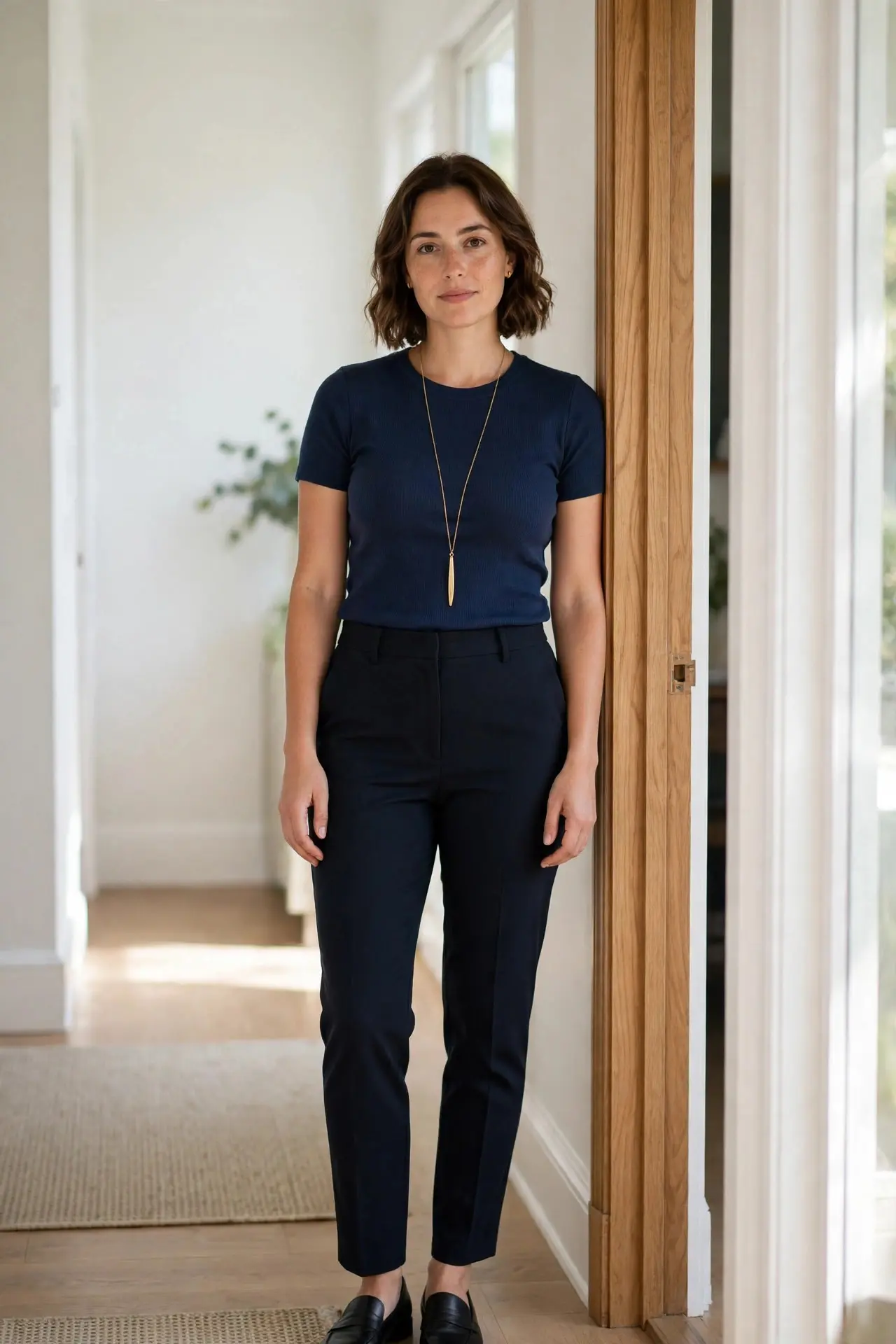
A chunky bib necklace is one of the fastest ways to undo a good outfit when you are petite with a full bust. All those clustered beads and layered plates land exactly on the fullest part of your chest, adding depth and width where you are working to create balance. Even a beautiful statement piece ends up competing with your bust instead of complementing it.
Swap it for a single chain of 24 to 30 inches, with the pendant dropping just below the bust. That length pulls the eye downward in one clean vertical line, lengthening your torso instead of chopping it. Keep the pendant slim — a small coin, a delicate bar — and no wider than about an inch, so it does not rebuild the bulk problem lower down.
Tip: Pull the attention upward, too: small studs or tiny huggie hoops frame your face and give the eye a second stop, so it travels face to neckline instead of parking on your bust.
Shop this look: Long Pendant Necklace and Silk Camisole.
14. Choose Slim Straps and Racerbacks for Support
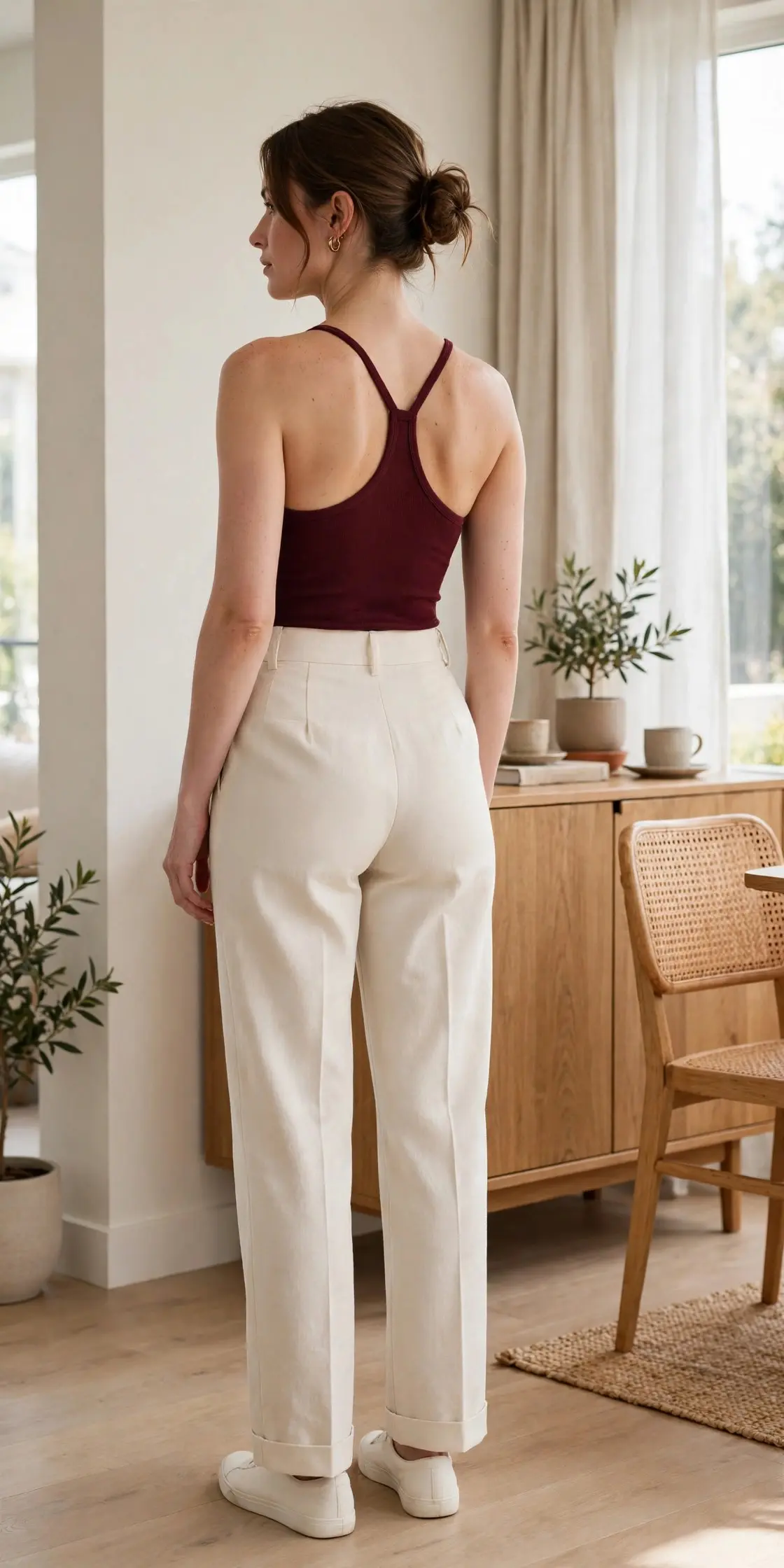
Wide-set, thick straps cause two problems at once: they visually widen your shoulders, and they slice your chest into segments that make your bust read broader across the top. Slimmer straps set closer together do the opposite — the line from shoulder to shoulder narrows, and your neckline reads as one clean, unbroken shape.
The racerback is the real workhorse. Drawing the straps toward the center of your back lifts the bust and brings it slightly inward, giving a more contained silhouette under tanks, fitted tees and sheath dresses. It also stops straps sliding off the narrow, sloping shoulders petite frames often have. A convertible bra with a J-hook gives you both strap styles in one bra.
Fit note: The band should carry about 80 percent of the support, not the straps. Test the racerback conversion in the fitting room under the exact top you plan to wear — some clips pull the cups wider instead of closer.
Shop this look: Racerback Tank Top and Sports Bra.
15. Master the Half-Size Shoe and Pointed Toe
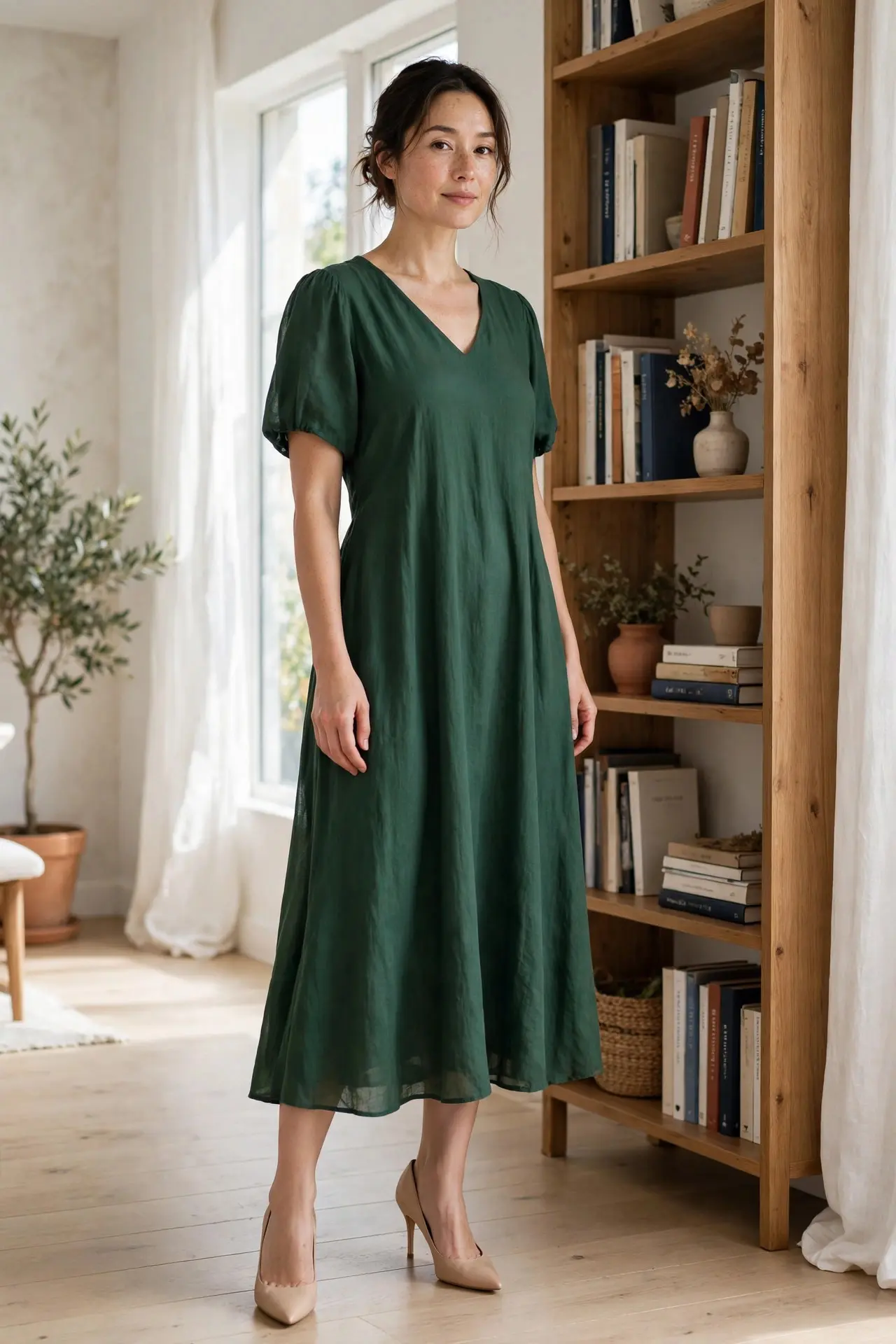
When your top half carries more visual weight, your legs need help holding up their end of the proportion — and a pointed toe is the easiest help there is. The elongated shape extends the line of your leg instead of stopping it short, adding visual length with no heel height at all. A slim block heel or low platform lifts the whole vertical line a step further.
Rounded and square toes are not banned, but they read shorter and wider — fine for casual days, less useful under a fluid dress or wide-leg trousers. If you buy one pair to flatter everything, make it a pointed flat or a two-to-three-inch pointed pump in a shade close to your skin tone or your hemline.
Tip: Consistently between sizes? Size up half and add a heel grip rather than squeezing into the smaller pair — pinched toes shorten your stride and your posture, undoing all that lengthening. Try new shoes at the end of the day, when feet are largest.
Shop this look: Pointed Toe Heels and Nude Heels.
Styling Tips
Think in thirds, not halves. An outfit split evenly top-to-bottom cuts a petite frame at its widest visual point. A shorter top over longer bottoms (or a cropped layer over a long column) reads longer and leaner.
Mind the hem map. Tops should end at the waistband or below the hip — never at the fullest point of the bust or hip. Trousers work best cropped at the ankle bone or full-length to the shoe; the in-between flood length shortens everyone.
Scale everything down. Small-to-medium prints, slim belts, delicate-to-medium jewelry and a small-to-medium structured bag suit a petite frame. One oversized element is a statement; three are a swamp.
Common Mistakes to Avoid
Buying regular sizes and leaving them unaltered. Long sleeves, dropped waists and hems pooling at the ankle quietly erase a petite frame. If it is not petite-cut, budget the alteration into the purchase.
Hiding in oversized tops. Volume over a full bust does not disguise it — it hangs from it, adding width everywhere. Skim, tuck or belt instead; definition is kinder than camouflage.
Tiny, delicate jewelry that disappears. A whisper-thin chain vanishes against a fuller bust and reads unfinished. Choose pieces with presence at petite scale: a slim pendant with a real drop, small hoops with some weight.
Cropping at your widest point. A jacket or cardigan that ends right at the bust or the widest part of the hip draws a line — and a spotlight — exactly there. End layers above it or well below it.
Building Your Petite Busty Capsule
Start before the clothes: get measured and invest in two bras that genuinely fit. It is the step almost everyone skips and the one that changes everything downstream — tops sit differently, waistlines land where they should, and hems stop riding up. Everything else in the capsule builds on that foundation.
Build the core around V-neck and wrap tops in fluid fabrics, high-rise bottoms that lengthen your legs, one excellent single-breasted blazer fitted at the shoulder, and a pointed-toe shoe that finishes the line. Add a long open cardigan, a belted fine knit and one column-of-color outfit, and you have weeks of combinations from a handful of pieces.
Finally, treat tailoring as part of the price, not an afterthought. A modest top nipped in at the waist will out-style an expensive one that fits nowhere. When your clothes are cut to your frame instead of fighting it, you stop dressing around your bust — and simply get dressed, balanced and polished.
Frequently Asked Questions
What neckline is most flattering for a petite woman with a large bust?
A V-neck or sweetheart, because both draw a vertical line that lengthens the torso and narrows the chest visually. Aim for a V ending three to four inches below the collarbone. Scoop necks work too if they are not too wide; be careful with high crews, and rescue them with a long pendant.
Should I buy petite sizes if I have a big bust?
Yes — petite sizing fixes sleeve length, torso length, shoulder position and waist placement. The catch: petite tops are usually drafted for a smaller cup, so buy for your bust first, then have the waist taken in and the hem shortened. It typically costs under $40 and makes the piece look made for you.
How do I stop buttons gaping on shirts with a full bust?
Look for shirts with a hidden snap between the buttons at the fullest point, or sew a small snap or hook-and-eye in yourself — ten minutes’ work. Fabrics with a little elastane gape far less than stiff cotton, and sizing up plus a waist alteration is often the cleanest fix of all.
What bras work best under thin or fitted tops for a busty petite frame?
A seamless underwire bra with side support, in your true band size. A snug band does the supporting, so straps stay comfortable instead of digging in. Skin-matching shades disappear under light tops, and a convertible style handles racerback and halter necklines without extra straps.
Can I still wear oversized or loose clothing with a large bust?
Absolutely — the trick is balance. Pair one oversized piece with one fitted piece: a loose shirt tucked into slim high-rise jeans reads effortless, while volume on top, volume below and no waistline reads shapeless. Define your waist somewhere, with a tuck, belt or wrap tie.
Final Thoughts
Dressing a petite, full-busted frame is not a puzzle with a missing piece — it is a short list of proportions you can repeat until they become instinct. Fit the foundation first, keep your lines vertical, and tailor without apology: these style secrets for petite women with big busts work whether you are building a work wardrobe or one perfect outfit. For more bust-friendly styling at every height, our guide to the best tops for big busts is the natural next read. Which of these 15 secrets will you try first?
Recommended Products
| Full Coverage Bra |
| Minimizer Bra |
| Sweetheart Neckline Top |
| V Neck Sweater |
| Black Wrap Top |
| Ruched Side Top |
| Silk Blouse |
| Satin Slip Skirt |
| Leather Belt |
| High Rise Skinny Jeans |
| White High Rise Jeans |
| Wrap Dress |